
Signs You Need Professional Alternator Repair Near You
If you are searching for “alternator repair near me” because your vehicle has dimming headlights, slow power windows, a glowing battery dashboard light, or engine stalling, schedule professional charging system diagnostics promptly. An automotive alternator generates electrical power for onboard electronics while replenishing the battery; when it underperforms, certified technicians perform diagnostic voltage testing (healthy units produce 13.8 to 14.5 volts) to determine whether component rebuilding or full unit replacement is necessary. Catching these early warning signs prevents cascade damage to surrounding hardware and ensures you are not left stranded on the shoulder of a busy highway.
Dimming Headlights and Accessory Malfunctions
One of the most frequent early indicators of charging failure involves erratic exterior and interior lighting. When an alternator cannot maintain adequate voltage, your headlights might noticeably dim at stoplights, pulse when you idle, or suddenly flare bright as you accelerate and engine RPMs rise.
Inside the cabin, inconsistent voltage starves high-draw convenience features of the juice they need to function. You might notice:
- Power windows rolling up at a frustratingly slow pace
- Seat warmers failing to heat up or turning off abruptly
- The infotainment display or radio cutting out randomly while driving
- Digital gauge clusters flickering or resetting intermittently
- Climate control blowers dropping speed unexpectedly
When electrical load outpaces the alternator’s real-time output, the vehicle’s onboard computer attempts to conserve power by shedding non-critical systems. If your stereo restarts every time you switch on the air conditioning or turn on your high beams, the charging system is screaming for an inspection.
Battery Warning Lights, Whining Noises, and Stalling
Modern dashboards feature a dedicated battery-shaped warning icon, or occasionally an indicator reading “ALT” or “GEN.” While many drivers assume this light strictly indicates a dead battery, it actually signals a voltage anomaly across the entire charging circuit. If output drops below approximately 13.0 volts or spikes dangerously high due to a broken internal regulator, the dashboard light illuminates immediately.
Mechanical noises under the hood present another clear warning sign. As an alternator operates, its internal rotor spins inside a copper stator on a set of precision high-speed bearings. Over time, heat and mechanical stress break down the internal lubrication, producing distinct sounds:
- Grinding or growling sounds: Worn or dirty internal bearings struggling to spin smoothly under engine load.
- High-pitched whining: Electrical diode failure creating electromagnetic harmonic resonance, or a drive belt slipping over a misaligned alternator pulley.
- Burning rubber or electrical smells: A seizing alternator pulley creating intense friction against the serpentine belt, or internal stator windings overheating from heavy electrical overload.
Ignoring these physical indicators carries serious consequences. If the alternator’s electrical output drops completely while driving, the ignition system and electronic fuel injectors will run entirely off the battery’s reserve capacity. Within a matter of miles, the battery drains completely, resulting in sudden engine stalling and the loss of power-assisted steering and braking.
Diagnosing Electrical Failures: Alternator vs. Battery vs. Starter
The automotive starting and charging network functions as an interdependent ecosystem consisting of three primary components: the battery, the starter motor, and the alternator. When your vehicle refuses to start or behaves erratically, determining which of these three parts failed is the first critical step toward resolving the problem effectively.
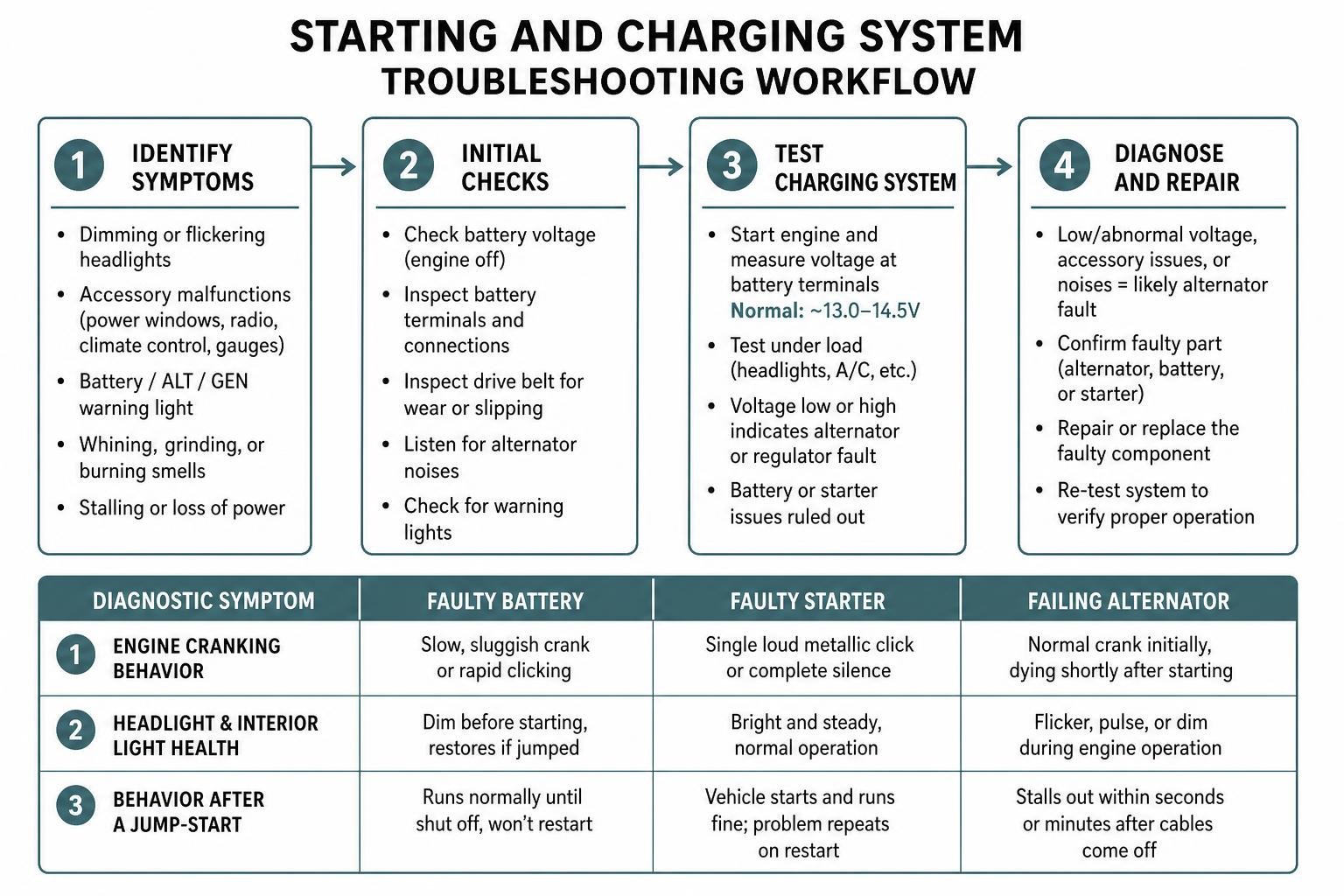
| Diagnostic Symptom | Faulty Battery | Faulty Starter | Failing Alternator |
|---|---|---|---|
| Engine Cranking Behavior | Slow, sluggish crank or rapid clicking | Single loud metallic click or complete silence | Normal crank initially, dying shortly after starting |
| Headlight & Interior Light Health | Dim before starting, restores if jumped | Bright and steady, normal operation | Flicker, pulse, or dim during engine operation |
| Behavior After a Jump-Start | Runs normally until shut off, won’t restart | Vehicle starts and runs fine; problem repeats on restart | Stalls out within seconds or minutes after cables come off |
| Dashboard Warning Lights | Battery light illuminated with ignition off | No charging warning indicators displayed | Battery/ALT light stays on continuously while driving |
| Audible Engine Bay Sounds | Rapid starter relay chattering | Single heavy clunk from starter solenoid | Whining, growling, or bearing grinding during idle |
| Electrical Accessory Stability | Weak before engine starts, fine once running | Perfectly normal accessory power output | Accessories cut out or malfunction while driving |
How to Tell Which Component Is Failing
To pinpoint the culprit without guessing, mechanics evaluate how the vehicle responds to ignition attempts and external jump-starts.
If your vehicle produces a rapid clicking sound when you turn the key, but the engine fails to turn over, the battery lacks sufficient cold cranking amps (CCA) to engage the starter solenoid. If the car starts immediately with jumper cables and continues to run without issue for hours—only to fail again the next time you turn it off—the battery has lost its internal capacity to hold a charge.
If you turn the key and hear a single, sharp metallic “clack” from under the engine, yet your headlights, radio, and horn operate at full strength, the starter motor or starter solenoid is mechanically jammed or electrically burned out. In this scenario, jump-starting provides zero benefit because the starter hardware itself cannot translate electrical current into rotational force.
Conversely, if your car starts with a jump but dies almost immediately after removing the jumper cables, the alternator is defective. In a healthy vehicle, the alternator generates all running electrical power once the engine fires; if it produces zero output, the engine stalls the instant external power disconnects. Using a digital multimeter across the battery terminals provides definitive proof: a resting battery shows ~12.6 volts, whereas an active, healthy alternator charges between 13.8 and 14.5 volts while idling. Anything registering below 13.2 volts indicates an underperforming charging unit.
Why Comprehensive Starting and Charging Diagnostics Matter
Replacing an electrical part without diagnosing the broader circuit is a costly gamble. A failing battery forces an alternator to work at maximum capacity constantly, causing internal overheating and premature wear. Similarly, a slipping serpentine belt or corroded ground strap can mimic complete component failure when the underlying problem is simply poor mechanical tension or electrical resistance.
Comprehensive starting and charging testing evaluates the full electrical loop. Technicians run advanced diagnostic sweeps to assess starter draw amperage, parasitic battery drain during key-off states, diode ripple voltage, and DC repairs for control wiring and connections. Isolating the true point of failure protects your investment and ensures secondary electrical issues don’t destroy your newly installed components.
Alternator Repair vs. Replacement: What to Expect
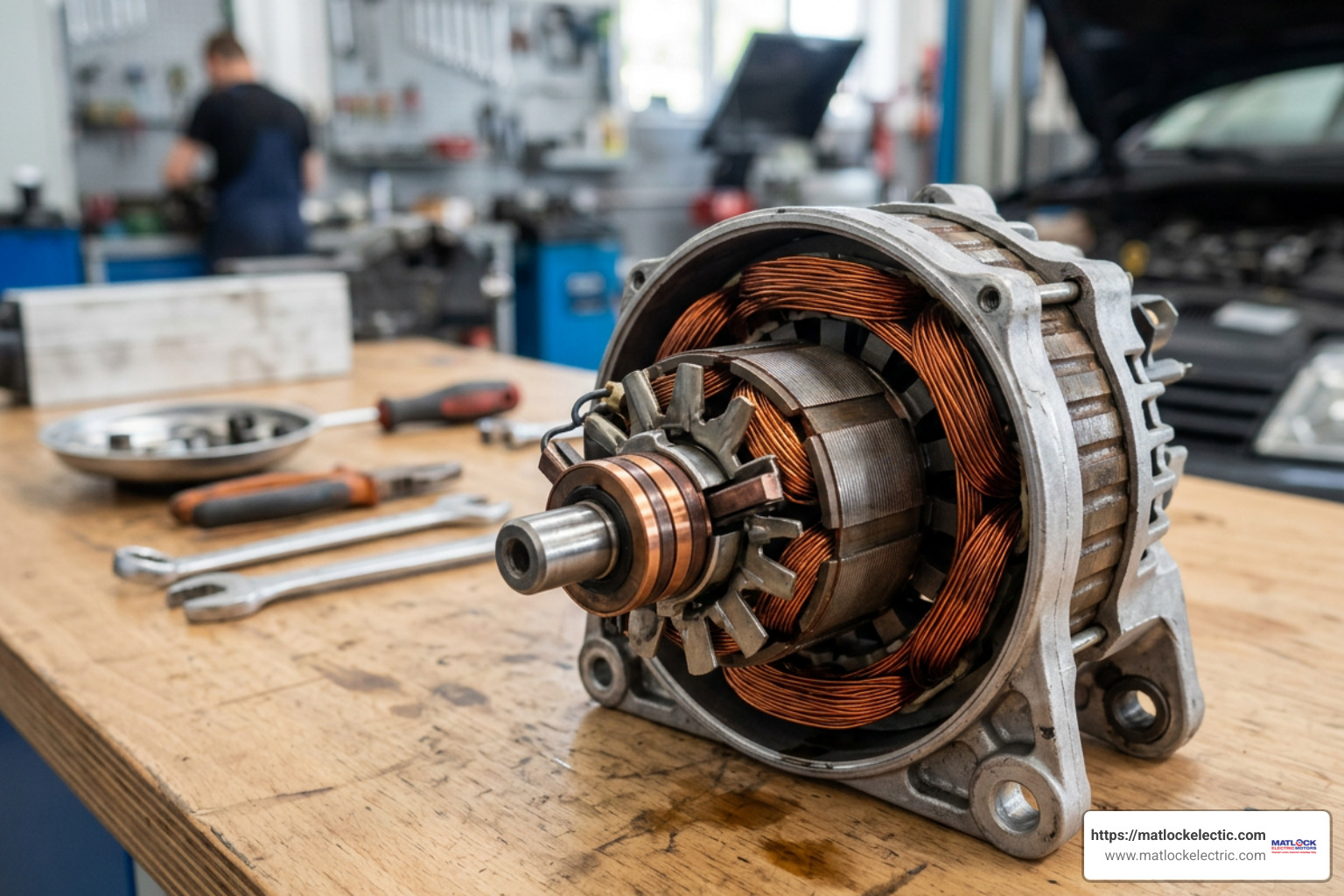
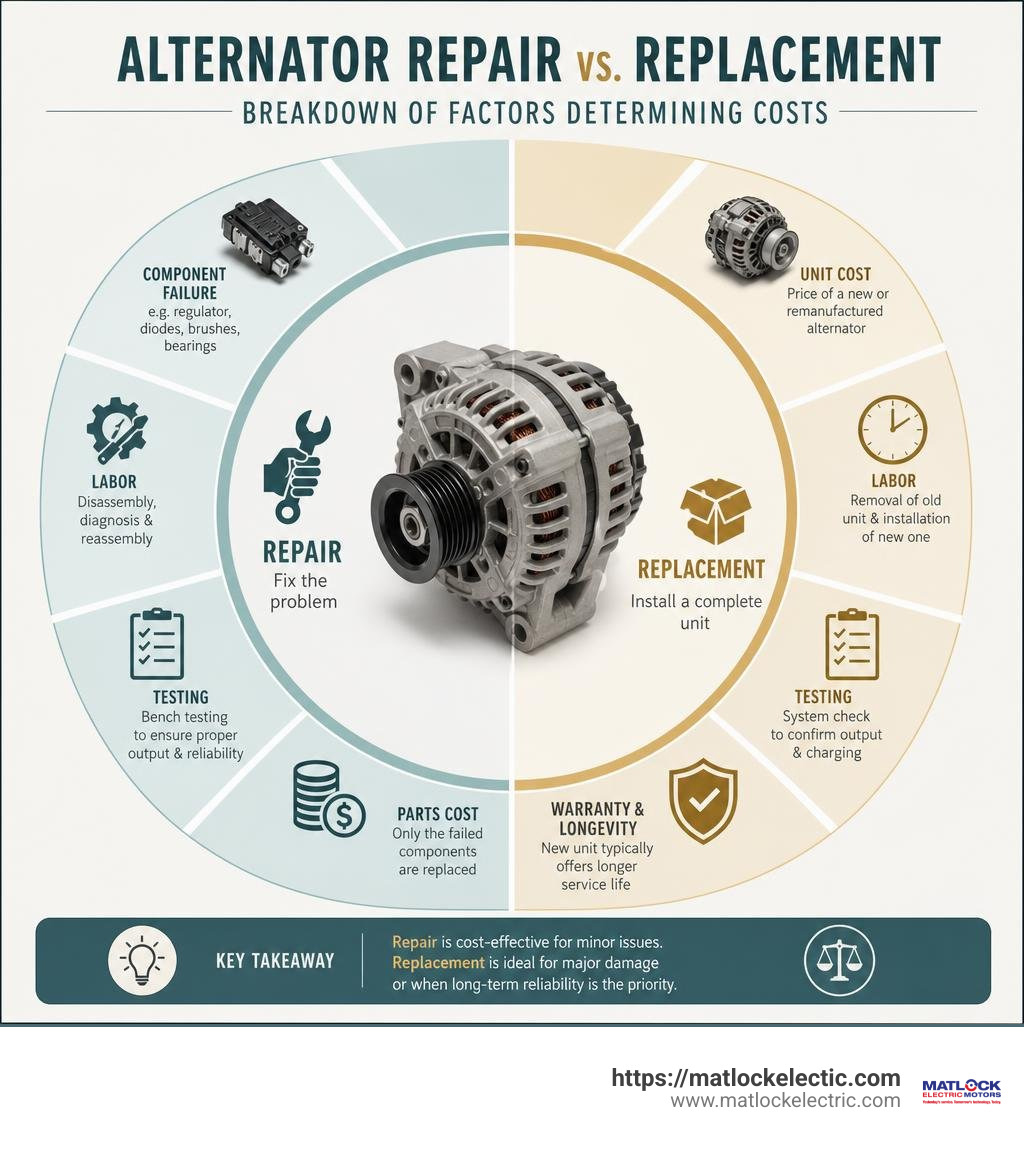
When an automotive repair shop diagnoses an alternator failure, drivers are often presented with two distinct paths: rebuilding the current unit or installing a complete replacement assembly. Both approaches have specific merits depending on vehicle value, part availability, and the exact nature of the mechanical or electrical failure.
When severe electrical damage occurs, selecting comprehensive repair services ensures the underlying hardware is returned to reliable factory specifications rather than temporarily patched.
What to Expect During Alternator Repair Near You
An alternator is an electromechanical assembly built from several individual components. Depending on the design and age of the unit, minor component-level service can sometimes restore full charging performance without replacing the entire housing:
- Voltage Regulator Replacement: The regulator maintains steady voltage output across changing engine speeds. If it fails, the alternator may undercharge (draining the battery) or overcharge (boiling battery acid and frying delicate electronics). Swapping an external or modular regulator resolves voltage fluctuation cleanly.
- Carbon Brush and Slip Ring Service: Spring-loaded carbon brushes ride along the spinning rotor slip rings to conduct electrical current. Over tens of thousands of miles, friction wears these brushes down until contact is lost. Installing new brush sets restores electrical continuity.
- Diode Rectifier Bridge Overhaul: The alternator generates three-phase alternating current (AC), which the internal rectifier bridge converts into direct current (DC) for automotive use. Replacing failed diodes eliminates AC voltage leakage and whining sounds.
- Bearing Replacement: High-grade front and rear mechanical bearings can be pressed out and replaced when dry friction causes grinding noises, eliminating mechanical drag before the rotor seizes entirely.
- Final Bench Testing: Following any internal repair or full unit rebuild, the alternator is mounted on an automated test bench to verify amperage output, load stabilization, and thermal tolerance under simulated driving conditions.
Common Causes of Alternator Failure
Alternators operate in extremely demanding environments, exposed to dramatic heat cycles, physical debris, and continuous rotational stress. The most common root causes of charging system failure include:
- Excessive Engine Heat: High ambient temperatures under modern, tightly packed engine bays degrade internal electrical insulation over time, breaking down the copper stator windings.
- Fluid Contamination: Leaking engine oil, power steering fluid, or engine coolant dripping directly into the alternator housing coats the brushes and slip rings, causing electrical arcing and rapid component failure.
- Drive Belt and Tensioner Wear: A loose or worn serpentine belt slips over the alternator pulley, resulting in erratic charging output, while an over-tightened belt destroys alternator bearings from excess radial load.
- Normal Operating Wear and Tear: Rotating electrical components naturally experience mechanical fatigue. Most original-equipment alternators are engineered to last roughly 80,000 to 150,000 miles before internal wear requires attention.
- Heavy Aftermarket Electrical Loads: Installing high-wattage sound systems, off-road light bars, or commercial inverters without upgrading to a high-output alternator overheats factory charging components, necessitating specialized AC repairs and power upgrades.
Turnaround Times and Estimated Service Costs
Navigating charging system issues requires understanding what a standard repair visit entails in terms of time and budget. Fortunately, because alternators are standard service items across modern vehicles, turnaround times are typically rapid, and parts availability is widely supported.
How Long Does Repair or Replacement Take?
For standard passenger cars, light trucks, and SUVs, an electrical diagnostic sweep generally takes 30 to 60 minutes. Once technicians pinpoint the alternator as the primary cause, the physical replacement or component repair usually takes between 1 to 2 hours of focused labor.
In most everyday scenarios, reputable repair centers offer same-day service, provided the appropriate replacement alternator or rebuild kit is locally available. Factors that can extend this timeline include:
- Tight, transverse engine layouts in compact cars requiring the removal of engine mounts, wheel liners, or air conditioning compressors to access the alternator bolts.
- Specialized European or high-end luxury platforms requiring brand-specific computer coding and battery registration following charging system installation.
- Sourcing specialized, high-amperage commercial or heavy-equipment alternators that require dedicated distribution freight.
Average Repair and Replacement Cost Factors
Total service costs vary across vehicle makes, mechanical accessibility, and component quality. In the current automotive market as of August 2026, standard alternator replacement for domestic and Asian passenger vehicles generally ranges between $450 and $950, including parts and labor. Premium European imports or specialized high-output heavy-duty platforms can range from $800 to $1,400+.
Key factors influencing your final service invoice include:
- Part Quality (OEM vs. Aftermarket Remanufactured): Original Equipment Manufacturer (OEM) brand-new units carry a premium price but provide pristine factory fitment. High-grade remanufactured units from certified rebuilders offer significant savings while retaining solid warranty terms.
- Labor Difficulty and Accessibility: Alternators mounted high on the front of an engine bay incur minimal labor costs, whereas units buried low against the firewall requiring subframe lowering demand higher labor hours.
- Collateral Component Replacement: Installing a fresh alternator on a frayed, cracked serpentine belt or a weak belt tensioner risks premature breakdown; replacing these related components during service adds modest parts costs while saving future labor fees.
- Battery Health Restoration: If a defective alternator drained the battery down to absolute zero, testing must confirm whether the battery can safely hold a charge or requires replacement alongside the alternator.
How to Choose a Trusted Local Repair Specialist
Entrusting your vehicle’s complex electrical architecture to a repair shop requires finding qualified technicians who utilize modern testing standards and back their workmanship with ironclad warranties.
How to Find the Best Alternator Repair Near You
When searching for dependable local technicians, look for shops that emphasize thorough diagnostic processes rather than fast guesswork. Consider these essential benchmarks:
- Certified Master Technicians: Look for facilities employing ASE-certified (Automotive Service Excellence) technicians who specialize in electrical and electronic systems (A6 certification).
- Comprehensive Multi-Point Testing: Choose a shop that explicitly tests the starter draw, battery capacity, parasitic key-off drain, and serpentine belt condition alongside the alternator.
- Transparent Estimates and Warranties: Reputable shops provide upfront written estimates itemizing parts and labor, backed by robust warranties, such as a 2-year/24,000-mile or 3-year/36,000-mile parts-and-labor guarantee.
- Verified Customer Feedback: Review recent local ratings to ensure the business demonstrates clear communication, timely turnarounds, and honest diagnostics without aggressive upselling.
If you operate commercial machinery, work vans, or industrial gear, utilizing specialized field services brings professional diagnostic capabilities directly to your location, eliminating costly towing expenses.
When to Seek Heavy-Duty and Industrial Rotating Equipment Specialists
Standard consumer auto garages are ideal for everyday commuter sedans, but commercial machinery, municipal fleets, manufacturing facilities, and heavy-duty vehicles require specialized expertise. Industrial alternators, massive emergency generators, and specialized power systems operate under severe duty cycles that exceed typical consumer shop capabilities.
When managing high-capacity power systems, working with dedicated rotating apparatus specialists capable of handling large-scale electric motors and high-amperage industrial generators guarantees that mission-critical equipment remains safe, efficient, and compliant with industrial reliability standards.
Frequently Asked Questions About Alternator Repair
Can I still drive my car with a bad alternator?
No, you should not continue driving with a failing alternator. Once the alternator ceases to produce adequate electricity, your vehicle relies entirely on the electrical energy stored inside the car battery. This reserve capacity typically lasts only 5 to 25 minutes depending on how many electrical accessories (headlights, wipers, AC, infotainment) are running.
When the battery runs flat, your engine will stall without warning. This causes an immediate loss of power-assisted steering, power brakes, and throttle response—creating severe safety hazards in heavy traffic or at highway speeds. If your battery warning light illuminates or your headlights begin dimming, immediately maneuver to a safe parking area or service center, or call for roadside towing assistance.
Does a failing alternator always require a complete replacement?
Not necessarily. In many instances, the core mechanical housing, rotor, and copper stator remain in excellent condition, with failure isolated to a single serviceable component such as the carbon brush set, front pulley bearing, or voltage regulator.
Specialized electrical rebuilders can disassemble the unit, replace the individual worn components, clean the internal contacts, and bench-test the assembly to restore factory-grade performance. However, if internal electrical arcing has burned the main stator windings or the cost of individual replacement parts approaches the price of a certified remanufactured unit, installing a complete replacement alternator is the most cost-effective, long-term solution.
Why does my battery keep dying after installing a new one?
If a freshly installed car battery dies within days or weeks of installation, the root cause is almost certainly an underlying charging system fault rather than a defective battery. When an alternator produces low voltage (undercharging), the battery must supply power to run the engine’s electronics, steadily draining its internal chemical reserves without receiving a recharge cycle.
Alternatively, a failed diode bridge inside an alternator can create an internal short circuit that causes a constant “parasitic draw,” siphoning power out of the battery while the vehicle is parked overnight with the engine switched off. A thorough electrical diagnostic test will quickly identify whether the problem stems from an undercharging alternator, high parasitic draw, or a loose serpentine drive belt.
Conclusion
Maintaining a dependable vehicle means keeping its starting and charging systems in top working order. The alternator acts as the powerhouse under your hood—converting mechanical engine power into the steady electrical current that keeps your safety gear active, onboard computers running, and your battery fully energized.
Catching warning signals like flickering headlights, slow power accessories, odd bearing noises, or an illuminated dashboard battery icon allows you to address charging issues before they leave you stranded. Whether your vehicle requires a simple belt tension adjustment, modular component servicing, or a complete unit replacement, professional diagnostic testing ensures you fix the real problem right the first time.
When managing complex vehicle machinery, commercial fleets, or heavy-duty rotating apparatus, rely on certified experts who understand electromechanical engineering from the inside out. Reach out to our team today to explore our full range of expert mechanical services and keep your vital electrical equipment operating at peak performance.