Key Differences and Common Causes of 3-Phase Motor Failure
To keep your facility running smoothly, it helps to understand what sets three-phase motors apart from single-phase designs. While single-phase units rely on phase-shifting capacitors to create starting torque, three-phase motors utilize three alternating currents offset by 120 electrical degrees. This continuous, rotating magnetic field provides high starting torque, superior energy efficiency, and reliable mechanical output without the need for auxiliary switches or capacitors. You can learn more about these foundational power principles by reviewing our guide on the Differences of AC/DC Motors.
Despite their industrial durability, three-phase motors operate under extreme electrical and mechanical stress. The primary causes of three-phase motor failure include:
- Voltage Imbalance and Single-Phasing: Even a minor voltage unbalance across phases leads to severe current unbalance, creating localized heat in the stator windings. If a phase drops entirely (single-phasing), the remaining windings draw excess current until thermal overload occurs.
- Bearing Degradation: Bearings bear the bulk of mechanical friction. Misalignment, improper lubrication, or mechanical overloading lead to fretting, scoring, and pitting. Worn bearings eventually cause the rotor to strike the stator core.
- Insulation Breakdown: Thermal stress, moisture ingress, and chemical contaminants degrade the insulation wrapping the stator copper wires, resulting in phase-to-phase shorts or ground faults.
- Thermal Overload: Continuous operation beyond nameplate full-load amps degrades winding insulation at an accelerated rate, cutting motor lifespan in half for every 10°C rise over operating limits.
Diagnosing Early Failure Signs
Catching a problem before a motor shorts out or seizes completely saves thousands of dollars in unplanned downtime. Advanced non-destructive diagnostic tools allow technicians to identify internal faults early.
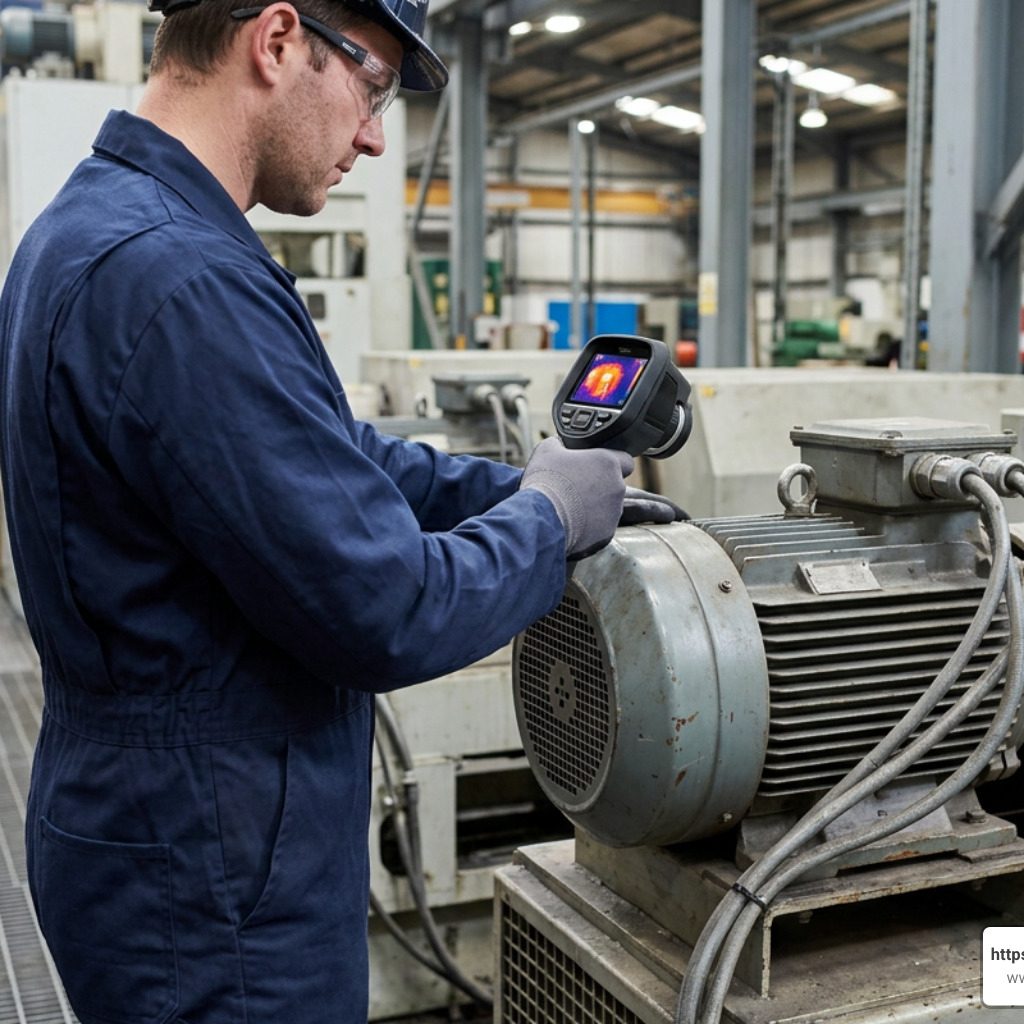
By evaluating vibration patterns, technicians can isolate mechanical misalignment from electrical unbalance or bearing race degradation. High-precision resistance meters check phase-to-phase balance to catch shorted turns, while megohmmeters measure winding insulation resistance to ground. To pinpoint thermal hotspots caused by high resistance connections or cooling fan failures, maintenance professionals rely on thermography; read The Story Behind Thermal Imaging to see how this technology reveals hidden defects.
Preventing Unplanned Industrial Downtime
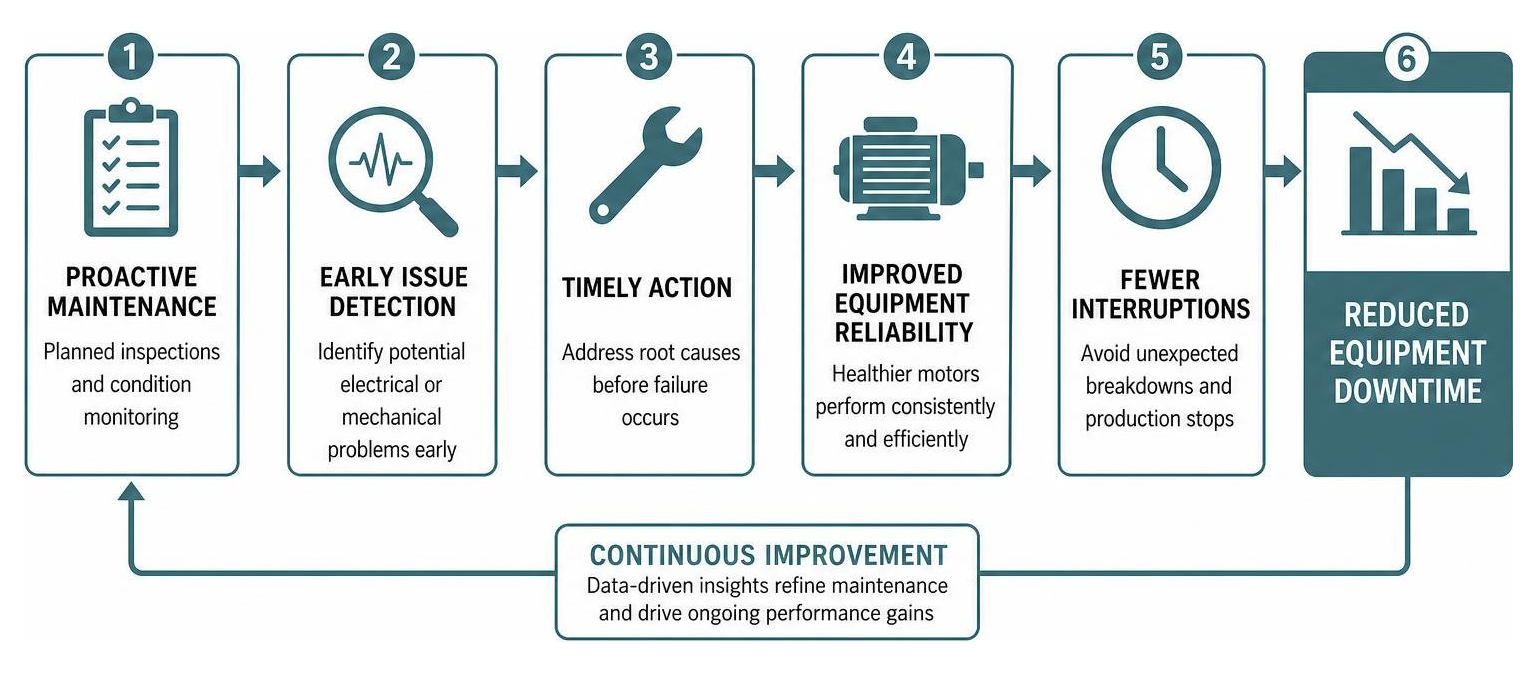
Unplanned production stops are among the most expensive challenges manufacturing plants face. Statistics show that roughly 80% of electric motor failures are preventable through early diagnostics and routine care.
Moving away from reactive fixes toward condition-based maintenance protects your bottom line. Integrating predictive practices like routine vibration monitoring and oil sampling keeps your machinery operating smoothly. To evaluate your current maintenance strategies, ask yourself: Is Your Plant Maintenance Proactive or Reactive?
What to Expect During 3 Phase Electric Motor Repair Near Me
When you send a critical motor to a local repair facility, a structured diagnostic and reconditioning workflow ensures the unit is restored to original equipment manufacturer (OEM) standards or better.
The turn-around time for motor servicing depends on whether the unit requires reconditioning, a mechanical rebuild, or a complete stator rewind:
| Service Type | Standard Turnaround Time | Emergency / Rush Turnaround |
|---|---|---|
| Basic Motor Rebuild | 3 to 4 Business Days | Available (24 Hours) |
| AC Motor Rewinding | 5 to 7 Business Days | Expedited Available |
| Full Shop Overhaul | 1 to 2 Weeks | Expedited Available |
Step-by-Step Workshop Repair Process
A professional industrial repair shop follows strict quality protocols during full-service AC motor repairs:
- Intake Inspection & Data Logging: Technicians document all nameplate data, terminal box configurations, housing orientations, and physical conditions upon arrival.
- Teardown & Mechanical Inspection: The motor is carefully disassembled. Technicians measure shaft journal tolerances and end-bell bearing fits using precision micrometers, checking against ISO 286-2 fit specifications.
- Core Loss & Stator Bakeout: If the windings are burned, the stator goes into a temperature-controlled burnout oven (not exceeding 270°F) to remove old varnish without damaging laminations. Core loss testing verifies lamination integrity.
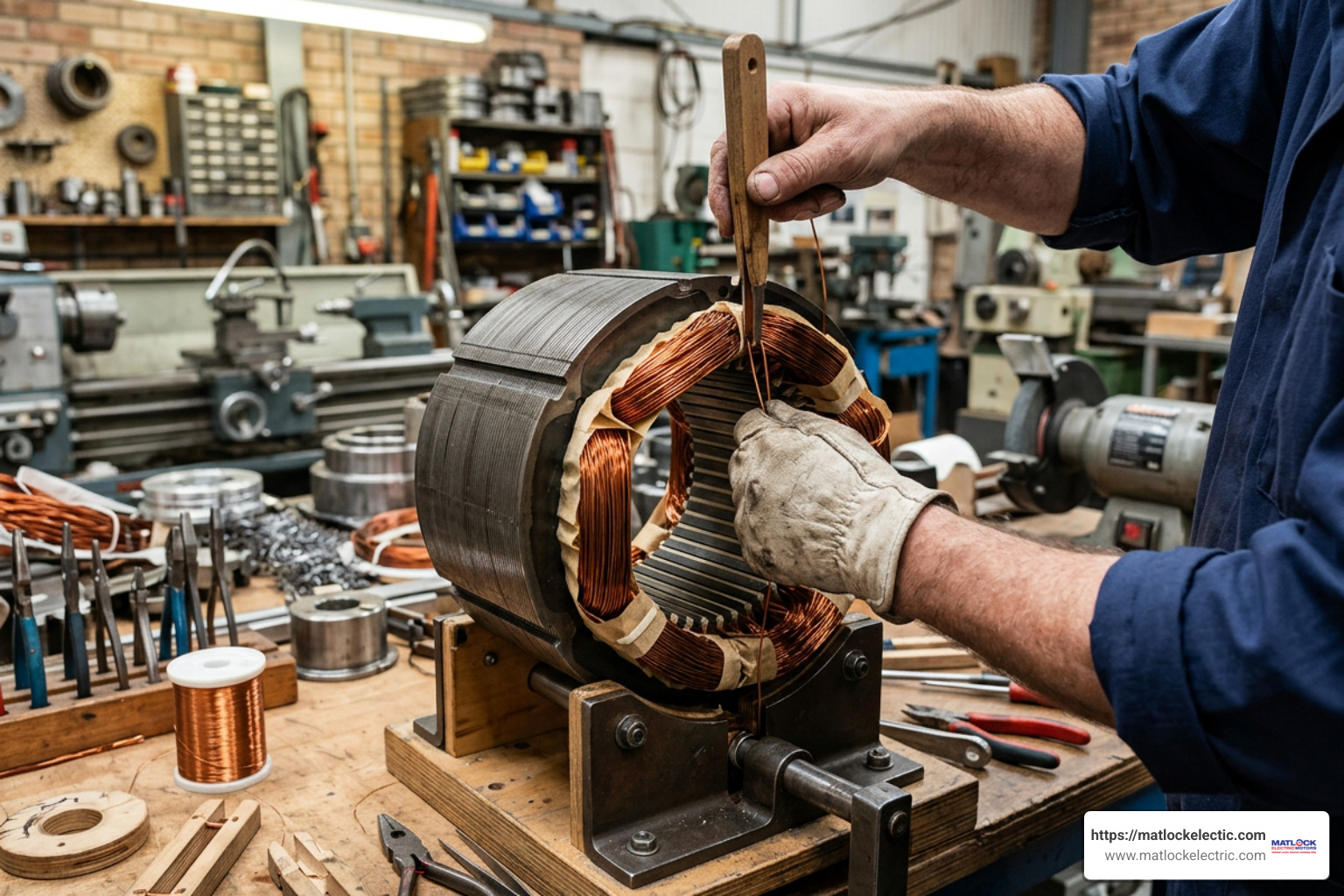
- Coil Rewinding & VPI: New copper coils are wound using premium magnet wire and Class F or H insulation. The stator undergoes Vacuum Pressure Impregnation (VPI) or controlled varnish dipping to eliminate air voids and block moisture ingress.
- Dynamic Rotor Balancing: To reduce vibration and extend bearing life, rotors are dynamically balanced to ISO 1940-1 standards (Grade G 2.5 or G 1).
- Reassembly & Machine Work: Worn shaft fits or end bells are built back to size using metalizing or precision welding before installing new premium bearings and seals.
- Drive Run Testing: The motor is mounted on a flat test bed and run under voltage for a minimum of 1 hour, logging no-load current, temperature rise, and vibration spectrums.
Advanced Diagnostic Testing Capabilities
To guarantee long-term field performance, repair centers utilize state-of-the-art testing equipment. High-potential (HiPOT) testing checks insulation dielectric strength, while surge testing detects turn-to-turn shorts within individual coils before full failure occurs. Modern diagnostic suites evaluate total motor health accurately; explore Technology in Diagnostics for an in-depth look at advanced testing methods.
3-Phase Motor Repair vs. Replacement: Making the Right Choice
Deciding whether to repair an existing motor or purchase a new one depends on motor size, repair costs, and availability.

As a general rule, repair costs for industrial electric motors fall between 30% and 60% of the cost of a brand-new replacement unit. Beyond price, lead times play a massive role: specialized new motors can face lead times up to 25 weeks due to supply chain constraints, whereas standard shop repairs take only days.
Horsepower Thresholds for Cost-Effective Repair
For standard NEMA frame motors rated at 100 horsepower and below, complete replacement is frequently more economical than performing a full motor rewind, unless the unit is specialized, custom-flanged, or face long delivery delays.
For high-horsepower motors (over 100 HP, extending up to 5,000 HP), rewinding and reconditioning deliver substantial cost savings while extending asset lifecycles. Modern rewinds often incorporate higher-grade slot insulation and copper wire than older factory models, improving thermal capacity without sacrificing efficiency.
Evaluating 3 Phase Electric Motor Repair Near Me Options
When searching for 3 phase electric motor repair near me, weigh total operational impact rather than initial price tags alone. Factoring in energy efficiency ratings (IE3 Premium or IE4 Super Premium) alongside total machine downtime helps you choose between off-the-shelf replacements and high-quality local repairs.
How to Choose a Local 3-Phase Motor Repair Service
Selecting the right industrial repair shop ensures your equipment is serviced safely, quickly, and to proper electrical specifications.
Key Criteria for Local Shop Selection
Look for these essential capabilities when evaluating service providers:
- EASA Compliance: Shops following Electrical Apparatus Service Association standards maintain certified quality controls that meet or exceed original factory performance.
- In-House Machine Shop: Centers that perform shaft metalizing, end-bell sleeving, and custom machining in-house avoid third-party delays and maintain tight quality oversight.
- Dynamic Balancing Capacity: Verify that the facility possesses heavy-duty balancing equipment capable of handling large rotor weights to prevent post-installation vibration.
- High-Voltage Testing Capabilities: Advanced shop test panels operating up to 4,160 VAC verify motor stability under real-world industrial loads.
- Warranty Backing: Reputable service facilities back their rebuilds and rewinds with comprehensive warranties (typically 12 months).
Finding Emergency 3 Phase Electric Motor Repair Near Me
When continuous operations suffer an unexpected breakdown, 24/7 availability is critical. Leading local service providers offer 24-hour emergency rush services, dedicated field troubleshooting, and local pick-up and delivery options to get your production line running with minimal delay.
Frequently Asked Questions About 3-Phase Motor Repair
How long does a standard 3-phase electric motor repair take?
Standard mechanical rebuilds and bearing changes generally require 3 to 4 business days. Stator rewinding typically takes between 5 to 7 business days. For emergency situations, 24-hour rush repair options are available from qualified local shops to mitigate downtime.
What are the signs that a 3-phase motor needs immediate service?
Key warning signs include tripped thermal overloads, excessive frame heat, abnormal humming or grinding noises, high vibration readings, burnt insulation odor, and voltage or current phase imbalances.
Is it better to repair or replace a motor under 100 HP?
For standard off-the-shelf motors rated under 100 HP, purchasing a new replacement is often more economical than a full stator rewind. However, if the motor has custom mechanical mounts, an unusual frame size, or faces extended factory lead times, reconditioning or rewinding remains the fastest, most cost-effective path.
Conclusion
Keeping your three-phase electric motors operating reliably requires proactive diagnostic monitoring and a trusted local repair partner. By catching early signs of winding wear, bearing fatigue, and phase unbalance, you prevent catastrophic equipment breakdowns and protect your plant from costly downtime.
When you need fast, dependable service, turning to an experienced service partner makes all the difference. Get professional support and restore your industrial equipment quickly by learning about Matlock Electric Motor Repair Services.