
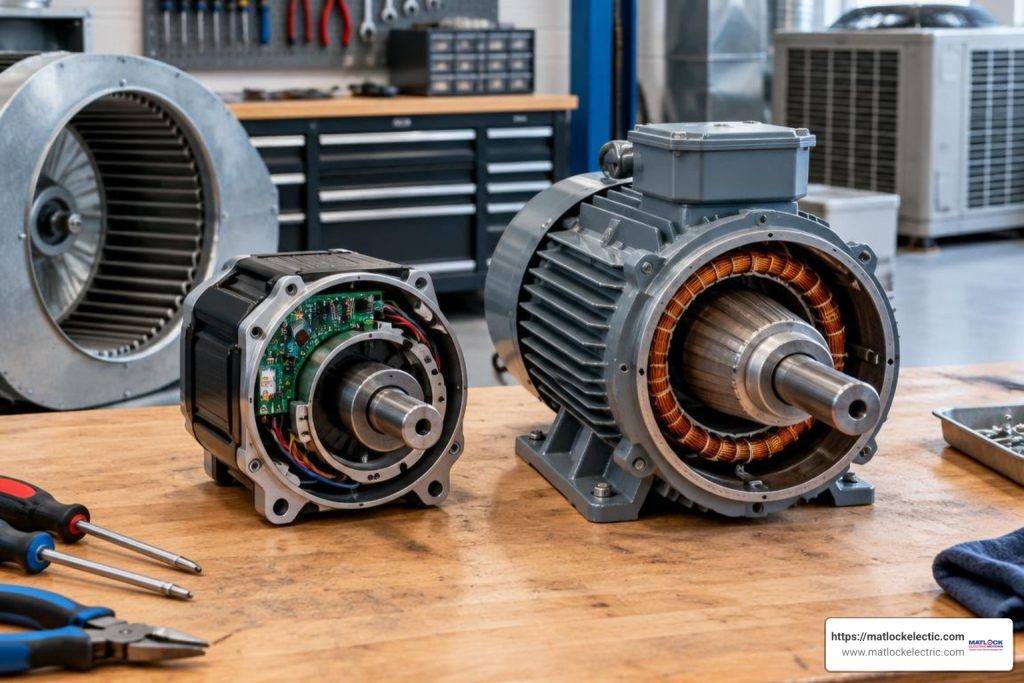
EC Motor vs AC Motor: Which Is the Better Choice?
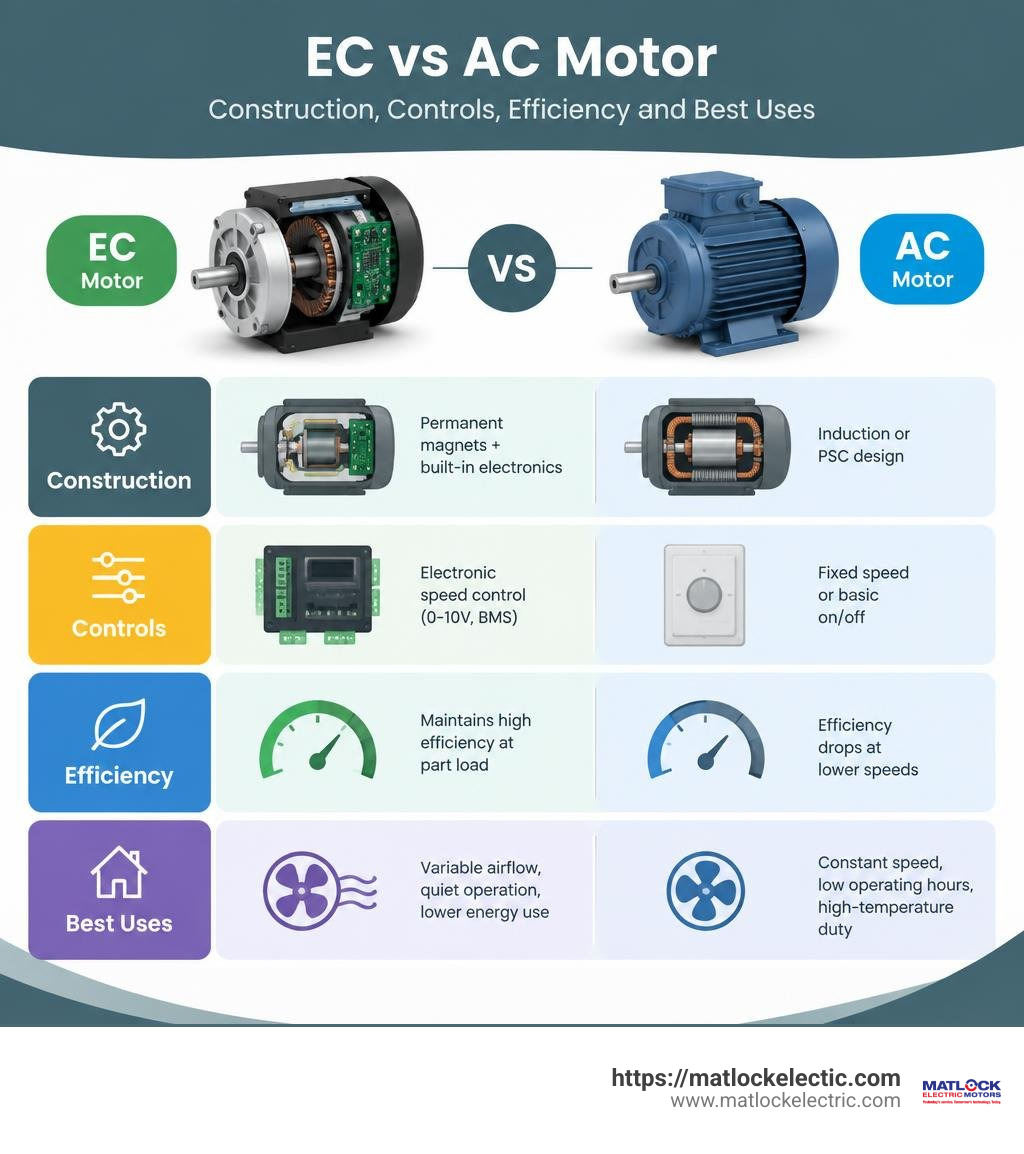
For most HVAC fans that run long hours and often operate below full speed, EC motors are usually worth the higher purchase price. They use built-in electronic controls and permanent magnets to maintain strong efficiency at part load, while standard AC induction and PSC motors often lose efficiency as speed drops.
| If your system needs… | Usually choose… |
|---|---|
| Constant speed, low operating hours, and low upfront cost | AC motor |
| Variable airflow, quiet operation, and lower energy use | EC motor |
| Simple on/off operation or high-temperature duty | AC motor |
| 0-10V control and easy BMS speed modulation | EC motor |
The biggest difference in the ec motor vs ac motor decision is not just peak efficiency. It is how the motor performs during normal operation. HVAC equipment rarely runs at 100% all day. In variable-load systems, EC motors can use substantially less electricity at partial load, with some applications showing savings of up to 60% versus standard AC alternatives.
AC motors remain a practical, durable option for fixed-speed fans, tight budgets, and demanding high-heat environments. But for air handlers, fan coils, cooling equipment, and other systems that frequently modulate airflow, EC technology can reduce energy, noise, and maintenance costs over time.
Ec motor vs ac motor helpful reading:
EC Motor vs AC Motor: Core Technology and Working Principles
To understand why these machines perform so differently in commercial facilities, we need to look beneath the end bells. While both deliver rotational power to blowers, impellers, and industrial equipment, their internal mechanics represent two distinct eras of electrical engineering.
Traditional AC drives rely on electromagnets to induce motion across an air gap. In contrast, an Electronically Commutated (EC) unit—often categorized alongside brushless DC (BLDC) or permanent magnet synchronous motors (PMSM)—combines direct-current rotor physics with onboard solid-state switching. Understanding these foundational designs helps clarify why modern facilities evaluate quality electric motors based on internal design rather than nameplate horsepower alone.
| Feature / Metric | Standard AC Induction Motor | EC (Brushless DC / Permanent Magnet) Motor |
|---|---|---|
| Rotor Type | Squirrel-cage aluminum/copper bars | High-grade permanent magnets (e.g., NdFeB) |
| Commutation Method | Line frequency alternating magnetic field | Onboard solid-state electronic switching |
| Peak Efficiency | 70% to 88% | 90% to 95% |
| Part-Load Efficiency | Drops significantly below 60% rated speed | Remains virtually flat down to 20% speed |
| Speed Regulation | Requires external VFD or stepped transformer | Integrated 0–10V, PWM, or Modbus control |
| Thermal Dissipation | Higher internal heat due to rotor slip | Minimal rotor heat; heat concentrated at electronics |
| Max Common Capacity | >1,000 kW (1,340+ HP) | Typically limited to 7.5 kW (10 HP) to 22 kW |
| Typical Lifespan | 10–15 years | 15–20+ years |
Construction and Operating Principles of AC Induction Motors
Standard AC induction motors operate on Faraday’s principle of electromagnetic induction. Alternating current passes through stator windings, generating a magnetic field that rotates at a speed governed by the power supply frequency (typically 60 Hz in North America). This rotating field induces an electric current in the conductive bars of the rotor (the “squirrel cage”).
Because the rotor requires this induced field to produce torque, it can never turn at the exact synchronous speed of the stator’s magnetic field. This inherent speed lag is called slip. Slip generates continuous internal rotor losses, which dissipate as waste heat.
In single-phase commercial applications, Permanent Split Capacitor (PSC) motors use run capacitors to create a secondary out-of-phase winding. While PSC designs are economical and simple, their operational efficiency drops rapidly when system pressure changes or when using stepped-voltage speed controls. Over decades of operation, identifying mechanical wear, bearing breakdown, or winding degradation requires rigorous protocols for diagnosing damaged AC motors before an unexpected failure halts plant operations.
How Electronically Commutated (EC) Motors Function
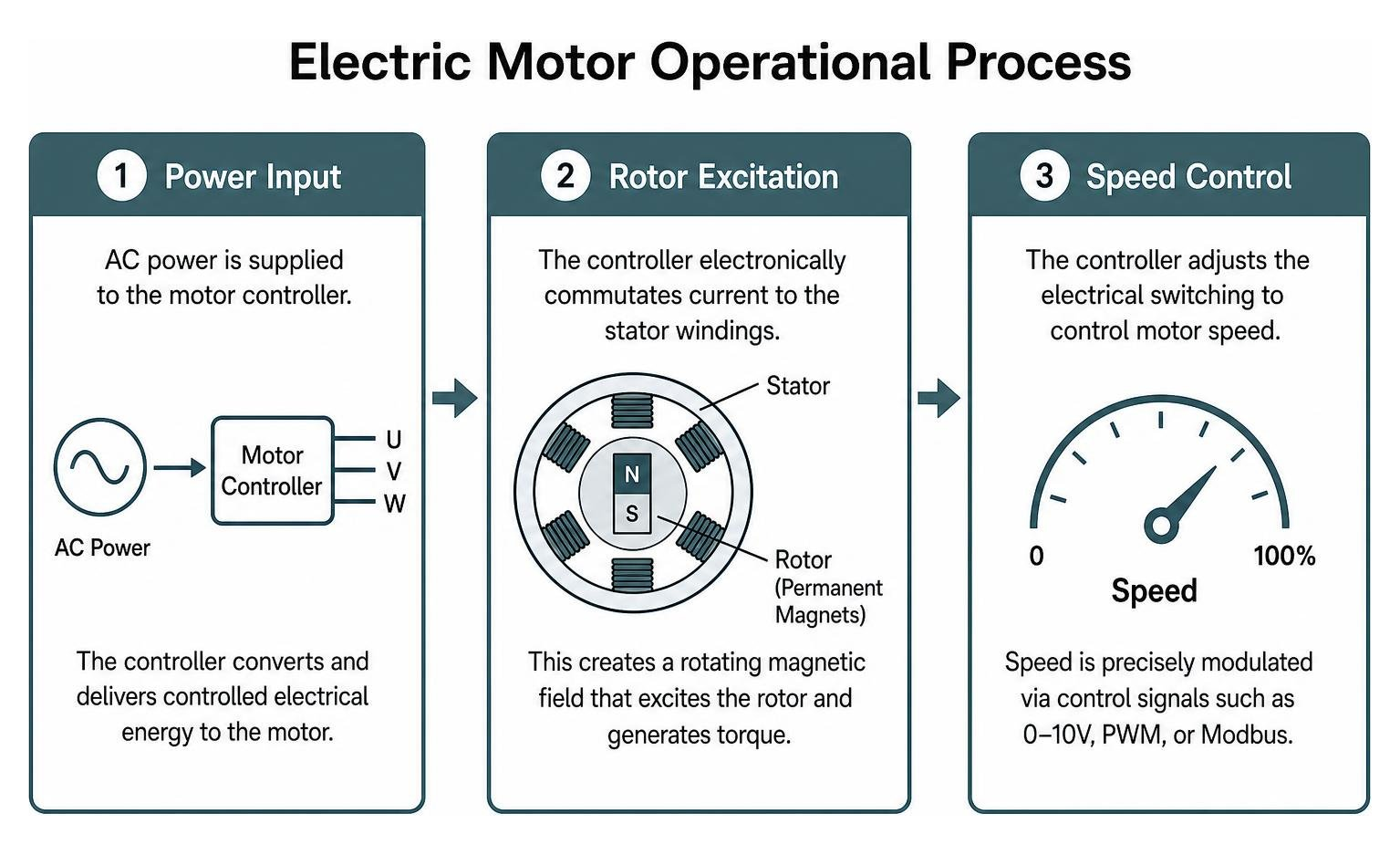
An EC motor operates as a brushless DC machine powered by an alternating current line. Mains AC voltage enters an onboard electronics module where rectifiers convert it directly into direct current (DC). An integrated microprocessor and inverter bridge then distribute DC voltage pulses to the stator coils in a precisely managed sequence.
Rather than relying on induced voltage across a slip gap, the rotor contains high-strength permanent magnets. Rotor position sensors (such as Hall-effect elements) or sensorless back-EMF tracking algorithms tell the microprocessor the exact angular orientation of the rotor at every microsecond.
Because the permanent magnets create their own constant magnetic field, the motor eliminates rotor slip losses entirely. No physical carbon brushes or mechanical commutators exist to wear out or spark. By understanding how DC motor armature testing isolates winding and magnetic health, facility managers can better appreciate how solid-state commutation removes mechanical wear points while delivering precise torque across all speeds.
Efficiency Comparison: Full Load vs Part Load Performance
When engineers evaluate motor efficiency on a catalog sheet, they often look exclusively at nominal, full-load operation (100% capacity). At 100% load, high-efficiency AC motors perform admirably, often reaching 75% to 88% efficiency. Top-tier EC motors deliver 90% to 95% efficiency at full load.
However, fans and pumps in commercial ventilation, data centers, and multi-zone buildings rarely run at 100% load. Systems are sized for peak design days—such as extreme summer heat waves—which represent less than 5% of annual operating hours. The rest of the year, systems modulate between 30% and 75% capacity to match variable indoor demand.
Part-Load Efficiency: EC Motor vs AC Motor Under Modulating Demand
Under modulating load conditions, the differences between these two motor topologies become stark. An AC motor throttled via a voltage controller or operating against high system impedance experiences sharp efficiency drops. Rotor slip increases, magnetizing current waste stays relatively static, and motor efficiency can fall below 50% when running at half speed.
EC motors possess an inherently flat efficiency curve across a broad speed spectrum. Because the rotor’s permanent magnetic field requires zero line power to sustain, the motor maintains a 20% to 25% efficiency edge over standard PSC motors even at mid-range speeds. When modulated down to 40% or 50% airflow, an EC fan system consumes up to 60% less electricity than equivalent voltage-regulated AC equipment.
Fan Affinity Laws and Modulation Curves
The physics of air movement make variable-speed operation exceptionally rewarding. According to the affinity laws:
- Airflow (CFM) is proportional to shaft speed ($RPM$).
- Static Pressure ($P$) is proportional to the square of shaft speed ($RPM^2$).
- Power Consumption ($P_{elec}$) is proportional to the cube of shaft speed ($RPM^3$).
$$frac{P1}{P2} = left(frac{RPM1}{RPM2}right)^3$$
Because power scales cubically, trimming fan speed by just 10% reduces theoretical power consumption by roughly 27%. Slowing the fan down by 20% reduces electrical demand by nearly 50%.
When an EC motor slows down, it takes full advantage of this cubic power reduction without suffering internal electrical drag or excess slip losses. Applying the principles of mastering variable operating speeds ensures your building management system (BMS) captures maximum savings without driving motors into unstable resonance zones.
Economic Breakdown: Upfront Investment, Operating Costs, and Payback
Making a capital expenditure decision requires balancing “Day-One” purchase costs against ongoing operational expenses (OpEx). While an EC motor or packaged EC fan carries an upfront price premium—often 2 to 3 times the initial cost of an equivalent fractional or low-horsepower standard AC motor—the operating energy savings typically recover that delta quickly.

Cost Analysis: EC Motor vs AC Motor Total Cost of Ownership
Electricity accounts for 85% to 95% of an electric motor’s total lifecycle cost. Initial purchase price rarely accounts for more than 5% to 10% of total lifecycle expenditures.
Real-world retrofits illustrate this dynamic clearly:
- Hi-Rise Fan Coil Units: In a multi-tenant residential property running fan coils continuously (8,760 hours/year at $0.18/kWh), upgrading from a multi-speed PSC motor (averaging 281 W) to an EC motor (averaging 213 W) saves approximately $107.72 per fan coil annually. Across a 300-unit building, that equates to over $32,000 in annual net savings.
- Dallas Data Center Facility: Retrofitting 36 legacy belt-driven AC centrifugal blowers with direct-drive EC plenum fans slashed baseline fan energy consumption by 36%, achieving full capital payback in just 2.3 years.
- Phoenix Industrial Cooling Tower: Replacing a 1.5 kW constant-speed AC fan motor with an EC axial fan package decreased annual energy consumption from 8,760 kWh down to 3,679 kWh—a 58% reduction that achieved ROI in 2.6 years at an average rate of $0.11/kWh.
- Berlin Commercial Complex: Upgrading an aged variable-air-volume (VAV) system to an intelligent EC direct-drive array lifted overall system operating efficiency from 57% to 82% across variable seasonal heating and cooling cycles.
Maintenance Savings, Equipment Lifespan, and Noise Reduction
Energy savings are only part of the financial equation; maintenance savings also contribute significantly to the bottom line:
- Brushless Longevity: Standard commercial AC motors typically achieve a service life of 10 to 15 years. Quality EC motors, operating cooler with lower internal vibration, routinely deliver service lives of 15 to 20+ years.
- Direct-Drive Mechanical Simplicity: Most EC retrofits eliminate pulleys, intermediate shafts, pillow-block bearings, and drive belts. Eliminating belts saves facility teams hundreds of labor hours in routine tensioning, belt replacement, and rubber particulate cleanup.
- Acoustic Improvements: In a Toronto hospital retrofit, replacing belt-driven AC assemblies with low-noise EC direct-drive fans yielded an average 10 dB(A) acoustic reduction at 50% part-load. Because decibels scale logarithmically, a 10 dB(A) reduction cuts perceived motor noise by half, solving tenant complaints in noise-critical spaces.
- Streamlined Diagnostics: Fewer mechanical parts simplifies predictive upkeep. Technicians can focus on fundamental testing routines, such as insulation and winding resistance diagnostics, rather than continuous mechanical rebuilding.
Control Architecture, Integration, and Retrofit Considerations
Implementing speed control with AC motors has historically required external hardware panels, adding cost and complexity to mechanical rooms.
Onboard Controls vs External Variable Frequency Drives
To modulate a conventional three-phase AC induction motor smoothly, you must install an external Variable Frequency Drive (VFD). VFDs convert line AC to DC and synthesize a pulse-width modulated (PWM) waveform to alter frequency and voltage.
While external VFDs provide robust industrial control, they introduce distinct challenges:
- Wall space requirements inside crowded electrical closets.
- Heat rejection inside control cabinets requiring dedicated cooling fans.
- Harmonics and high-frequency voltage spikes ($dV/dt$) that can degrade stator insulation or cause electrical bearing fluting unless filtered.
- Extra installation labor for shielded cabling, bypass contactors, and external line reactors.
EC motors sidestep these issues by embedding the inverter bridge and digital signal processor directly inside the motor housing. Facility engineers can modulate fan speed directly using a simple 0–10 VDC analog signal, a pulse-width modulation (PWM) input, or digital network protocols like Modbus RS-485 and BACnet.
While legacy plants often manage initial inrush current using traditional soft starters, EC systems incorporate smooth, programmable ramping directly into their onboard microcode, eliminating high inrush current spikes automatically.
Key Retrofit Verification: Mounting, Airflow, and Controls
Replacing an AC motor assembly with an EC direct-drive package is a true system retrofit, not just a simple motor swap. Before ordering hardware, review this verification checklist:
- Mounting Footprint and Geometry: Direct-drive EC fans mount differently than legacy foot-mounted AC motors with belt pulleys. Check whether your air handler cabinet requires a custom bulkhead adapter plate to support the direct-drive plenum fan frame.
- Static Pressure and Operating Points: Direct-drive impellers spin at shaft speed without belt-pulley ratio multiplication. Verify that the EC fan curve delivers adequate static pressure across high-resistance ductwork and loaded filtration banks.
- Control Signal Availability: Ensure your local terminal controller or Building Management System (BMS) can supply a continuous 0–10V or 4–20mA analog control loop, or provision a stand-alone potentiometer/pressure transducer to modulate the motor.
- Enclosure Ratings and Environmental Sealing: Verify the environmental ingress protection (IP) rating of the EC electronics package. If retrofitting harsh outdoor rooftops or washdown zones, review guidelines for selecting ODP vs TEFC motor enclosures to prevent moisture and particulate damage to sensitive electronics.
- Electrical Supply Characteristics: Check supply voltage and phase carefully. Many commercial EC fans accept single-phase 120/230V or three-phase 208–480V mains power directly, converting phase internally to drive the multi-pole permanent magnet rotor.
HVAC Applications, Operating Limits, and Environmental Trade-offs
Despite their high efficiency, EC motors are not a universal replacement for every industrial application. Selecting the right motor requires matching technology to the specific operating environment and load profile.
Ideal Application Scenarios for EC and AC Systems
Where EC Motors Deliver Maximum Value:
- Variable Air Volume (VAV) Air Handlers: Facilities where static duct pressure and cooling demand fluctuate continuously throughout the day.
- Fan Coil Units (FCU) & Unit Ventilators: Multi-zone hospitality, medical, and multi-family residential buildings running 24/7/365 where quiet operation and part-load efficiency compound savings.
- Cleanroom Fan Filter Units (FFUs): Semiconductor and pharmaceutical cleanrooms requiring precise laminar airflow balancing and low heat generation inside the clean zone.
- Data Center CRAH / CRAC Units: Continuous-duty air handlers where a 30% drop in fan energy generates substantial operational savings.
Where AC Induction Motors Remain the Smarter Choice:
- Continuous-Duty, Fixed-Speed Industrial Exhaust: Processes where fans run strictly at 100% capacity around the clock without modulating airflow.
- Emergency Smoke-Spill & Life-Safety Fans: Dedicated high-temperature exhaust systems designed to evacuate hot toxic gases during building fire emergencies.
- High-Horsepower Industrial Machinery: Heavy rock crushers, high-pressure pumps, extruders, and large industrial fans requiring ratings above 30 kW (40 HP) to several megawatts.
- Extreme Low-Speed Applications: Specialized low-velocity mixing equipment that uses gearboxes paired with durable low-RPM slow-speed motor drives.
Thermal Limitations, Capacity Ceilings, and Environmental Factors
To make an informed engineering choice, consider these three operational boundaries of EC technology:
- Thermal Sensitivity and Magnet Demagnetization: Standard EC motors incorporate neodymium-iron-boron (NdFeB) or ferrite permanent magnets. If ambient air temperatures exceed roughly 125°F (52°C), or if internal winding temperatures spike under severe overload, these magnets can suffer permanent thermal demagnetization, causing catastrophic torque loss. Standard AC induction motors withstand much higher thermal extremes without magnetic failure.
- Horsepower and Physical Size Ceilings: The vast majority of commercially available EC fan packages top out around 7.5 kW (10 HP), with specialized units reaching up to 22 kW. For multi-hundred-horsepower heavy industrial infrastructure, rugged AC induction motors controlled by external VFDs remain the undisputed industry standard.
- Supply Chain and Environmental Realities: Permanent-magnet manufacturing relies heavily on rare-earth mining and specialized refining processes (with global production exceeding 230,000 metric tons annually). By contrast, AC induction motors use widely available, fully recyclable electrical steel, copper wire, and cast iron.
Frequently Asked Questions About EC and AC Motors
Can an AC fan motor be directly replaced with an EC motor?
Yes, in most low-to-medium horsepower HVAC applications, an AC motor or belt-driven fan assembly can be retrofitted with an EC direct-drive unit.
However, you must verify the physical mounting footprint, check that your control system provides a compatible 0–10V or digital speed signal, and confirm that the direct-drive impeller satisfies the system’s design airflow and static pressure requirements across all filter states.
Do EC motors require an external Variable Frequency Drive?
No. EC motors do not require an external VFD because variable-frequency switching circuitry is already built into the motor housing.
The onboard electronics handle rectification, phase distribution, and speed regulation internally. You simply provide line-voltage power and a low-voltage analog (0–10V, PWM) or digital (Modbus) control signal to modulate speed smoothly from 10% to 100%.
Why are AC motors still preferred in high-temperature applications?
AC induction motors rely on durable copper or aluminum rotor bars that tolerate elevated operating temperatures without losing their electromagnetic properties.
EC motors rely on permanent magnets and sensitive onboard microprocessors. High ambient heat (such as emergency smoke-extraction duty or ovens operating above 125°F/52°C) can cause thermal demagnetization of the rotor magnets and destroy onboard solid-state components.
Conclusion: Making the Right Motor Decision
Choosing between an EC motor and a traditional AC motor comes down to evaluating your system’s operating duty cycle, airflow variability, and long-term operating costs.
If your equipment operates at a constant speed, runs for limited annual hours, faces extreme operating temperatures, or requires high horsepower (>15 HP), rugged AC induction motors remain a dependable and cost-effective choice.
However, for commercial air handling units, cooling towers, variable-air-volume boxes, and fan coils that modulate speed to meet fluctuating building loads, the EC motor provides clear operational advantages. By virtually eliminating rotor slip losses, maintaining flat efficiency curves down to low speeds, cutting acoustic signatures, and removing belt maintenance, EC retrofits routinely pay back their initial capital premium within 2 to 3 years.
To explore the differences in core motor architectures and choose the right technology for your facility, review our engineering guide on the fundamental differences of AC and DC motors, or reach out to our engineering team to evaluate your facility’s motor performance, repair needs, and efficiency upgrade options.