Key Types of Motors Offered by Electric Motor Vendors
When consulting electric motor vendors, understanding the underlying mechanical and electrical requirements of your application is the first step toward getting the right drive unit. Electric motor suppliers categorize their inventory primarily by current type, internal rotor design, and duty cycle.
Selecting the right unit requires looking closely at speed stability, starting torque, continuous output, and repairability. For a detailed breakdown of these fundamental power delivery mechanisms, review our detailed guide on the differences of AC and DC motors.
Overview of AC vs DC Motors for Electric Motor Vendors
The fundamental divide in the electric motor market sits between alternating current (AC) and direct current (DC) architectures:
- AC Motors (Induction and Synchronous): Powered by an alternating current source, these units are the workhorses of continuous-duty industrial processing. Standard three-phase AC induction motors operate without mechanical brushes, making them exceptionally reliable for driving constant-speed machinery like industrial pumps, exhaust fans, blowers, and bulk material handling conveyors.
- DC Motors: Powered by direct current, DC motors excel in applications requiring high starting torque, aggressive acceleration profiles, and precise low-speed regulation without external inverter controls. They remain standard equipment in heavy-duty paper mills, steel processing, power generation, and specialized hoisting.
Because industrial environments utilize both technologies, maintenance and component lifecycle management are crucial. If your equipment encounters insulation breakdown, worn mechanical parts, or severe coil damage, we provide full support for both AC repairs and DC repairs to restore performance without necessitating immediate, full-system replacements.
When selecting between these platforms, industrial buyers can review our complete inventory via our electric motor sales page to find units matched to exact system power demands.
Brushed vs Brushless DC Motors from Specialized Electric Motor Vendors
Within the direct current category, specialized electric motor vendors differentiate between brushed and brushless (BLDC) motor designs.
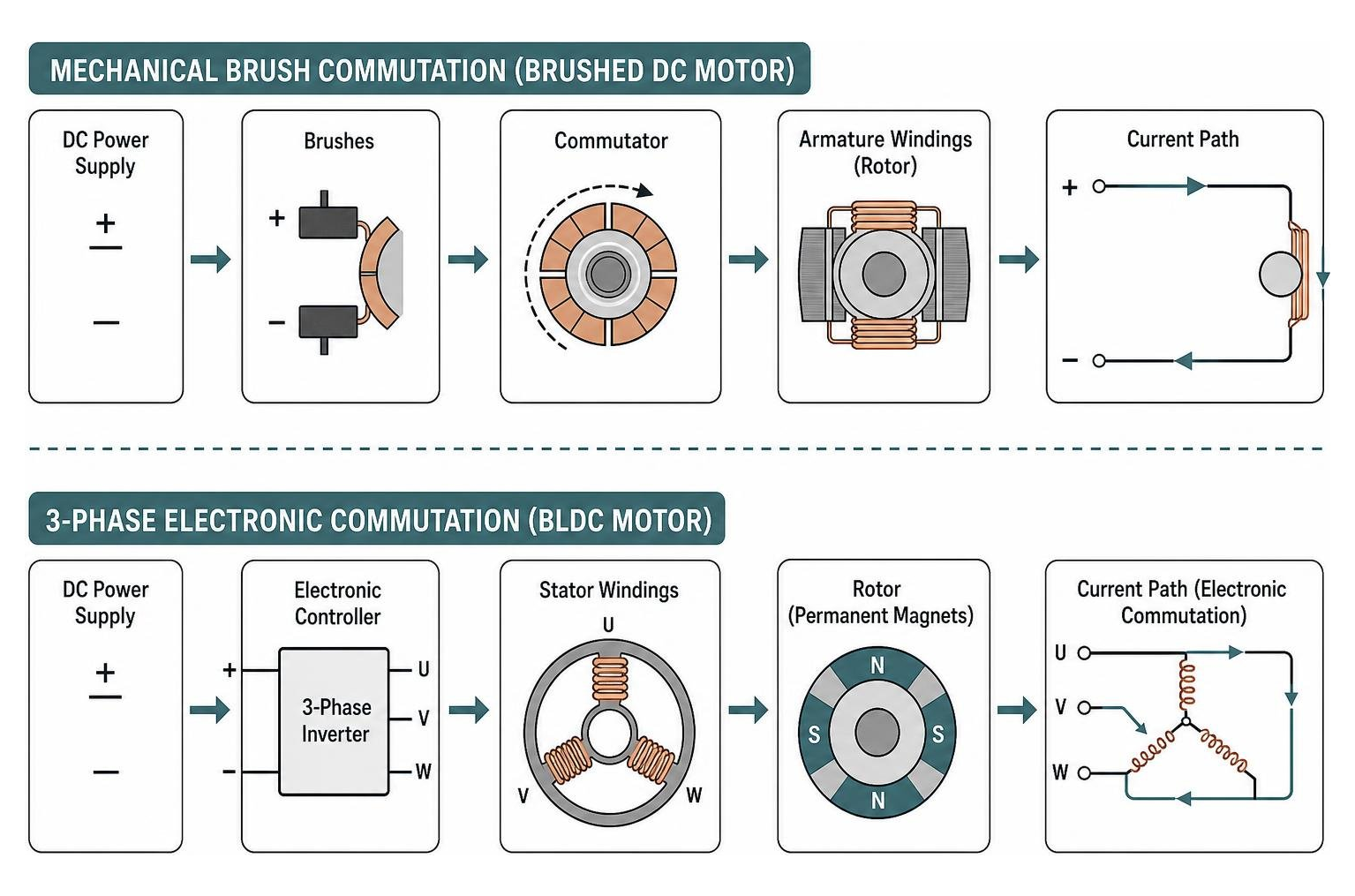
- Brushed DC Motors: These traditional motors use physical carbon brushes sliding against a rotating commutator to reverse electrical current within the armature windings. They feature simple electrical controls, operating directly from a DC voltage source without complex electronics. However, the continuous friction creates carbon dust, mechanical wear, and electrical arcing, requiring routine brush replacement and commutator servicing.
- Brushless DC Motors (BLDC): BLDC motors invert this design by placing permanent magnets on the rotating shaft while fixed windings sit within the stator. Electronic controllers handle commutation instead of physical brushes. Eliminating mechanical brushes yields higher energy efficiency, reduced noise, zero carbon dust, and an extended operational lifespan often exceeding 5,000 hours (limited primarily by bearing wear).
Modern industrial OEMs frequently partner with established motor vendors—such as Bodine Electric Company, which has manufactured AC and DC electric gearmotors since 1905, or specialized BLDC manufacturers like Shenghe—to source precision drives. Specialized manufacturers like Modar Motor offer frameless BLDC stators and rotors tailored for robotics, medical devices, and automated machinery.
You can browse full component listings in our standard electric motor catalog to locate compatible replacement hardware.
Evaluating Factory New vs New Surplus Sourcing Options
When sourcing industrial drive hardware, electric motor vendors frequently offer options categorized as Factory New or New Surplus. Navigating these sourcing options helps procurement teams balance immediate equipment lead times against total project costs.

- Factory New Motors: These units ship directly from the manufacturer or authorized distributor. They carry full factory warranties (typically 12 to 36 months), guaranteed complete documentation, and direct OEM technical backing. Factory new motors are recommended for critical continuous-duty production lines, hazardous environments, and applications where regulatory compliance requires full traceability.
- New Surplus Motors: New surplus inventory consists of unused, overstock, or legacy line motors that were purchased for projects but never installed, or acquired from canceled industrial projects. Industrial vendors often back these unused items with seller-provided warranties (commonly 90 days). Sourcing new surplus allows companies to acquire high-grade industrial hardware at a 30% to 50% cost reduction, while also serving as a vital channel for obtaining discontinued motor frames no longer produced by major factories.
To compare current availability across factory new and surplus categories, visit our electric motor sales hub.
Role of Variable Frequency Drives (VFDs) in Motor Speed Control
In modern industrial facilities, an electric motor is rarely operated in isolation. Variable Frequency Drives (VFDs) serve as essential electronic controls that vary the frequency and voltage supplied to three-phase AC induction motors.
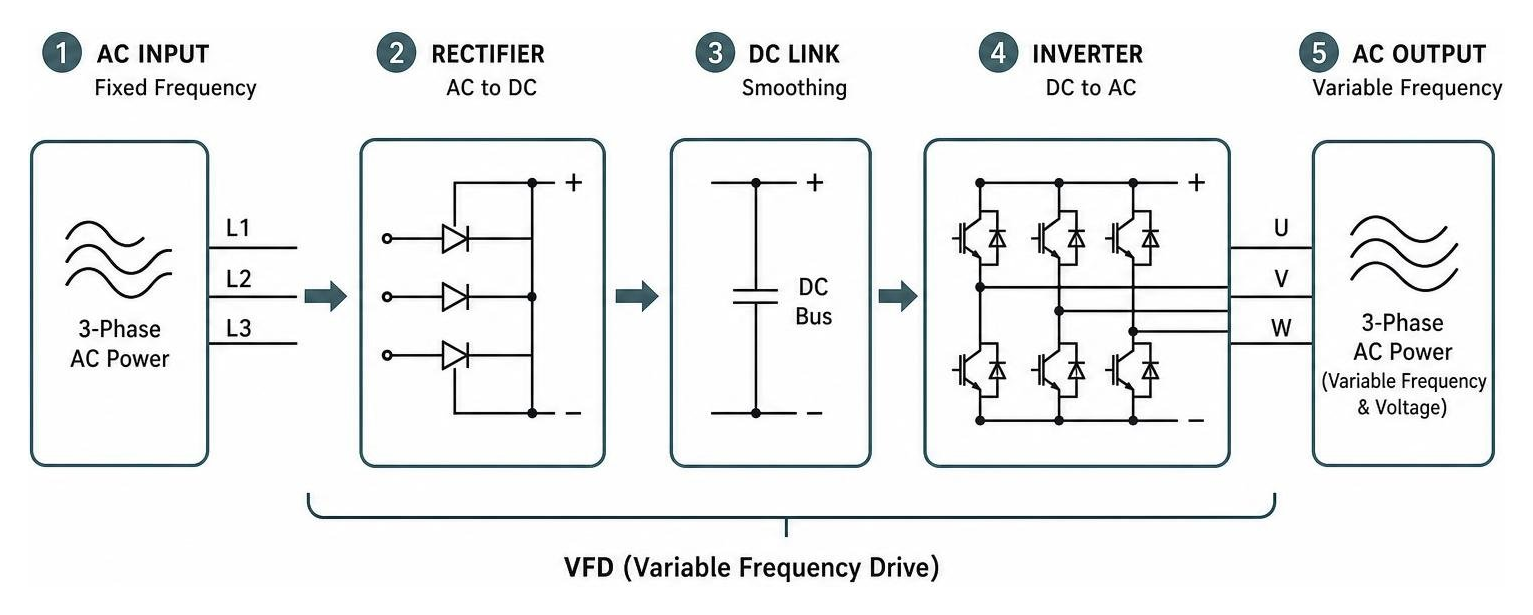
Key benefits of integrating VFDs into motor control systems include:
- Precise Speed Regulation: VFDs allow operators to dynamically adjust motor shaft speed to match varying process loads (such as throttling a pump or conveyor belt) rather than running the motor continuously at maximum RPM against mechanical dampening devices.
- Soft Starting Capabilities: Directly connecting an AC motor across the line can draw starting electrical currents up to six to eight times the full-load rating. VFDs gradually ramp up frequency and voltage during startup, mitigating inrush current spikes, reducing electrical grid disruption, and eliminating harsh mechanical shock on drive belts, gearboxes, and couplings.
- Single-Phase to Three-Phase Conversion: Small industrial facilities, workshops, or commercial sites lacking utility 3-phase electrical lines can utilize single-phase input VFDs to create balanced 3-phase power output, allowing standard 3-phase industrial motors to operate efficiently on single-phase utility power.
- Integrated Overload Protection: VFDs monitor operating current, thermal rise, and phase loss, acting as active protection modules to trip the circuit before electrical faults destroy motor internal windings.
Explore modern power modulation and speed control options through our dedicated drives and controls division.
How to Choose the Right Industrial Electric Motor Vendors
Selecting among global electric motor vendors requires evaluating their product lines, technical compliance, and inventory breadth. Top global manufacturers set international design benchmarks:
- ABB & Siemens: Recognized global leaders in smart industrial motor design, automation integration, and high-efficiency low-to-medium voltage drive systems.
- WEG & Nidec: Heavyweights providing expansive options spanning severe-duty industrial motors, agricultural drives, and specialized appliances.
- Regal Beloit, GE Electric, Schneider Electric, & Toshiba: Key suppliers specializing in HVAC, power distribution, energy generation, and continuous process industries.
- TECO Electric & Machinery: Prominent global producer of heavy-duty industrial drives and machinery systems.
In addition to large international brands, high-capacity long-standing regional manufacturers play vital roles in custom engineering. For example, Shenyang Electric Machine Manufacturing Co., Ltd. brings over 70 years of manufacturing experience exporting heavy-duty motors to more than 40 countries. Similarly, specialized suppliers like Menzel Elektromotoren focus on large custom-engineered industrial electric motors and direct legacy replicas up to 10,000 kW. Manufacturers such as Simo Motor provide comprehensive high and low-voltage AC/DC lines backed by historical manufacturing expertise.
To streamline vendor evaluation, use the comparison matrix below:
| Vendor Category | Best Suited For | Key Advantages | Potential Limitations |
|---|---|---|---|
| Global Tier-1 Manufacturers (e.g., ABB, Siemens, WEG) | Major plant automation, standardized global facilities | High energy efficiency standards, advanced smart IoT features, global compliance | Premium pricing, longer custom lead times, strict minimum volume limits |
| Specialized OEMs (e.g., Bodine, Shenghe, Modar) | Custom equipment manufacturing, BLDC, compact gearmotors | Precision engineering, custom frame/shaft modifications, honest direct specs | Application-specific product focus, lower extreme high-power coverage |
| Heavy Industrial Motor Builders (e.g., Shenyang, Menzel, Simo) | Mining, heavy metallurgy, large custom replacement builds | High power outputs, environmental drop-in legacy motor replication | High shipping weight considerations, specialized installation requirements |
| Distributors & Surplus Stockists (e.g., Regional Supply Houses) | Fast replacement, legacy line replacement, budget limits | Same-day shipping, large combined SKU access, discounted surplus pricing | Seller-backed short warranties on surplus stock, fluctuating stock volume |
For tailored advice on selecting qualified vendors, connect with our team through our electric motor sales department.
Essential Motor Selection Factors and Specifications
To ensure seamless installation and avoid premature equipment failure, engineers must establish precise physical and electrical parameters prior to ordering from electric motor vendors:
- Horsepower (HP) & kW: The rating of continuous mechanical work the motor can produce without overloading. Fractional horsepower (FHP) units are rated under 1 HP (746 Watts).
- Speed (RPM) & Torque: Armature output speed under full operating load. Torque reflects the turning force required to start and move the connected mechanical load.
- Voltage & Phase Rating: Power availability must match plant service (e.g., single-phase 115/230V or three-phase 230/460/575V up to 13.8 kV for high-voltage industrial drives).
- Frame Size Standards: In North America, NEMA frame standards (e.g., 56C, 145T, 256T) fix mounting bolt patterns, shaft height, and shaft diameter to guarantee physical drop-in interchangeability across brands. Internationally, IEC standards govern these physical parameters.
- Enclosure Types (NEMA/IP Ratings):
- Open Drip-Proof (ODP): For clean, indoor, dry operating environments.
- Totally Enclosed Fan-Cooled (TEFC): Prevents free exchange of outside air, protecting internal parts from dust, moisture, and mild corrosive elements.
- Washdown Duty: Sealed to IP-66 or IP-69K standards using stainless steel construction for daily sanitation in food and pharmaceutical plants.
- Explosion-Proof (Ex): Heavy-duty enclosures engineered to withstand internal gas or dust explosions without igniting surrounding hazardous ambient atmospheres (Class I / Division 1 or Division 2).
Review exact technical specifications across our inventory via our electric motor catalog.
Key Industry Certifications and Compliance Standards
A major benchmark of quality when screening electric motor vendors is verifying adherence to recognized international standards:
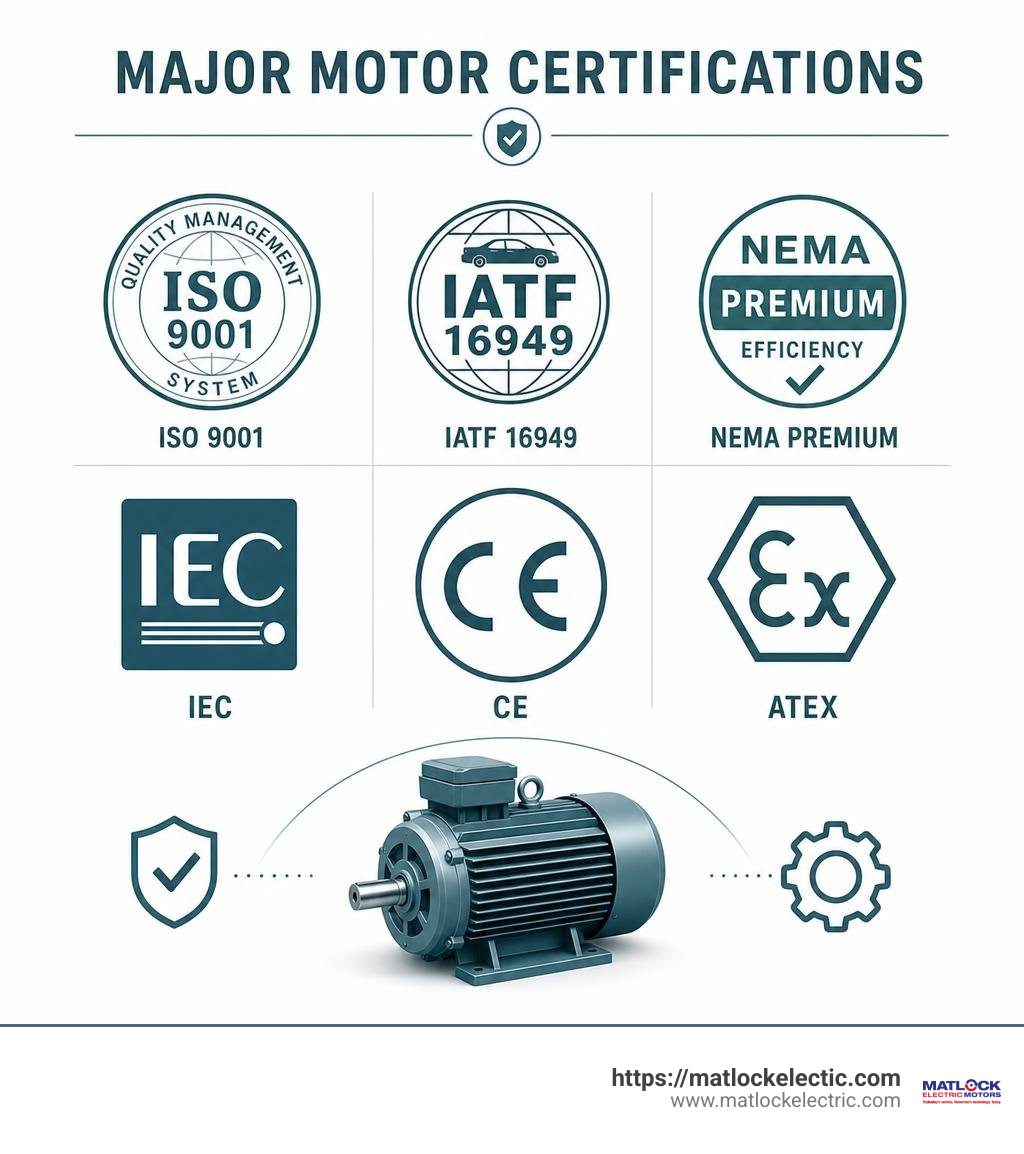
- ISO 9001 & IATF 16949: ISO 9001 validates that the manufacturer uses a standardized quality management system throughout design and assembly. IATF 16949 represents an advanced quality standard mandatory for vendors supplying automotive-grade drive components.
- NEMA Premium & IEC Efficiency (IE3/IE4): Energy efficiency standards set performance criteria to lower electrical power consumption. Premium efficiency motors reduce continuous operating costs in heavy industrial plants.
- Safety & Hazardous Location Certifications: Standards including UL, CE, RoHS, and ATEX guarantee that motors operate safely under extreme operating conditions and meet strict environmental safety guidelines.
Cross-reference your plant’s compliance standards with the specs listed in our electric motor catalog.
Motor Maintenance and Preventing Common Causes of Equipment Failure
Even top-tier motors sourced from trusted electric motor vendors will fail prematurely if subjected to improper installation or neglected maintenance.
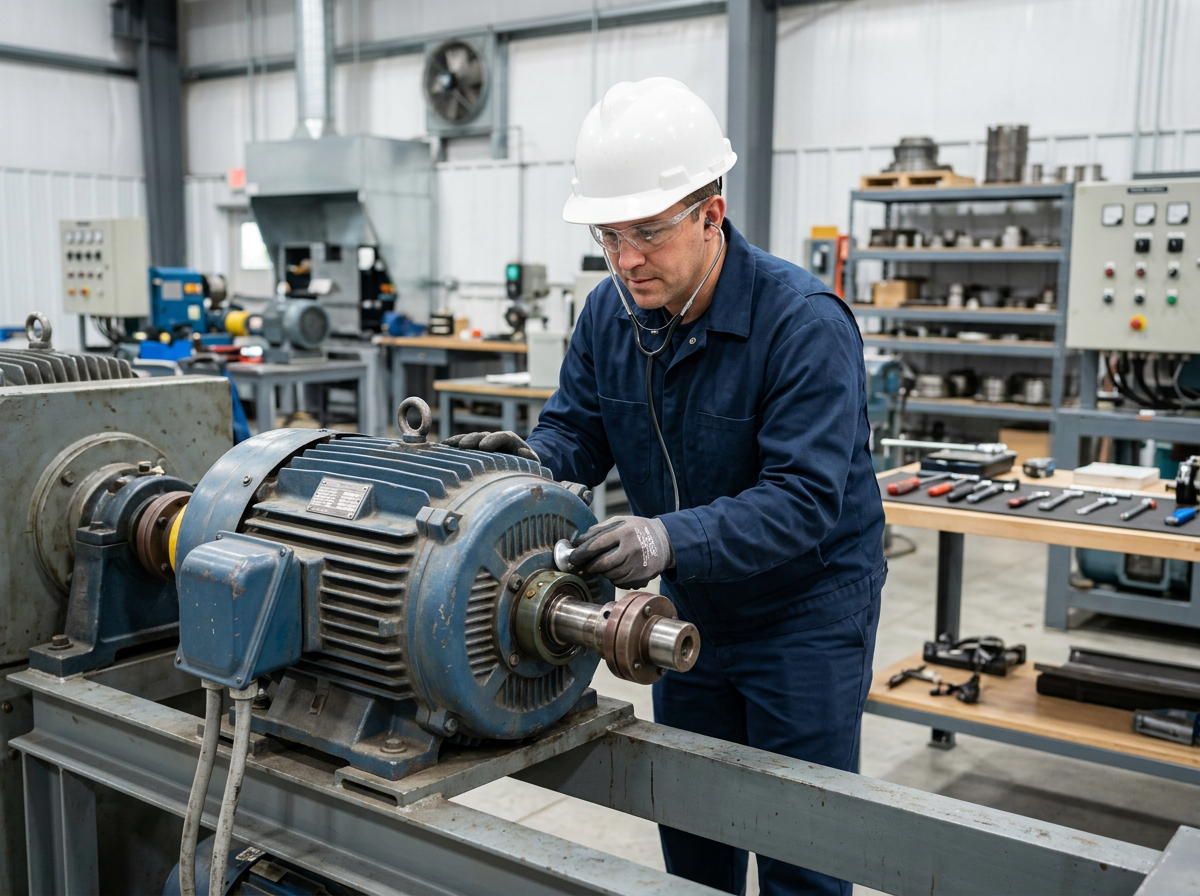
Understanding the primary causes of operational failure allows plant managers to implement effective preventative maintenance schedules:
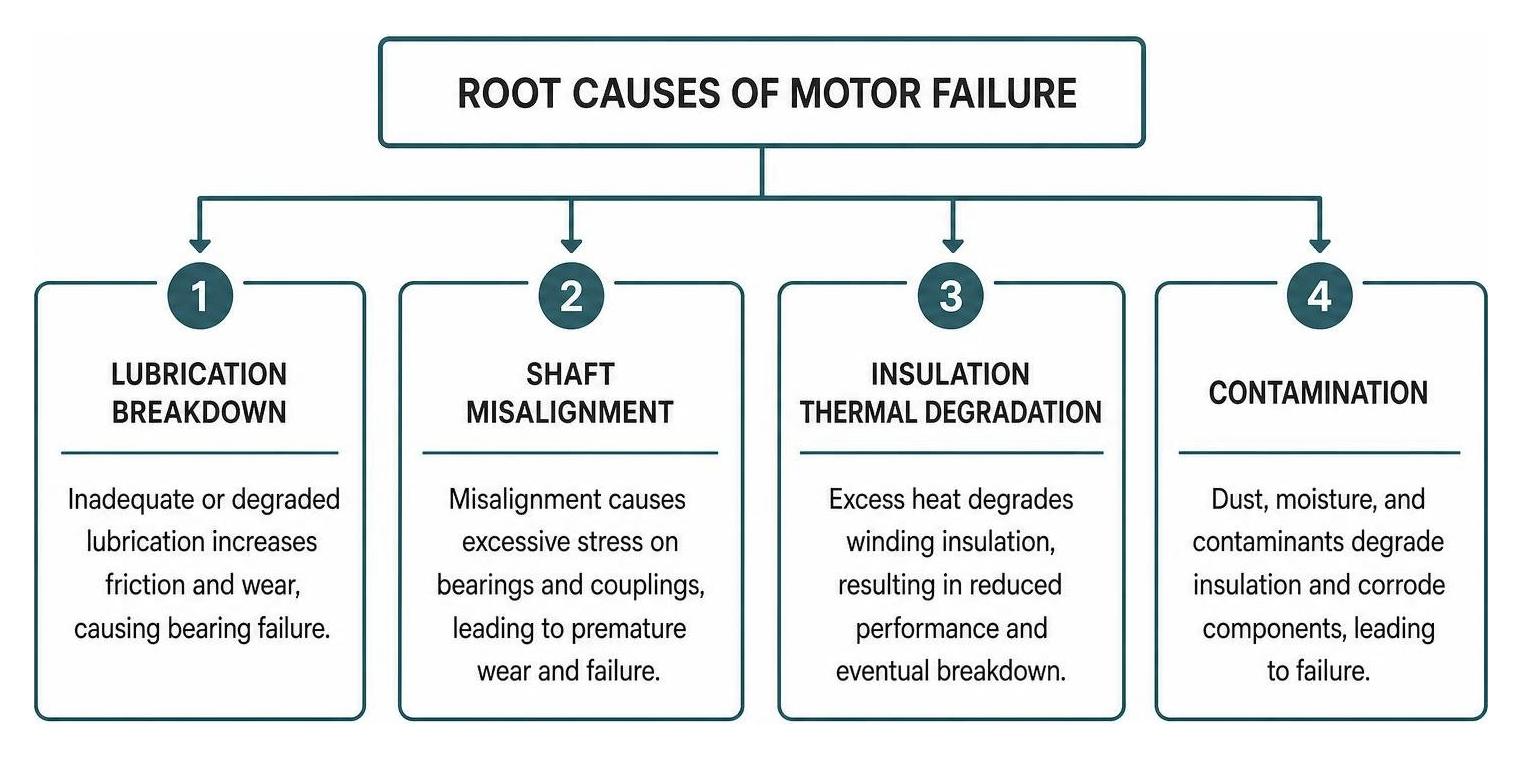
- Bearing Breakdown: Worn bearings represent the leading mechanical cause of motor failure. Bearing degradation stems from improper lubrication (over-greasing or under-greasing), shaft misalignment, or unmitigated rotor vibration. Inspecting bearing noise and monitoring vibration signatures early prevents complete shaft lockup.
- Thermal Overload and Insulation Failure: Excess heat degrades the internal copper winding insulation. Operating a motor above its rated temperature class—caused by blocked ventilation paths, excessive ambient heat, continuous electrical overloads, or voltage imbalances—causes short circuits within the stator windings.
- Shaft Misalignment: Improper alignment between the motor output shaft and the driven equipment load forces radial and axial loads onto internal bearings, destroying seals, warping shafts, and tearing up drive couplings.
- Contamination & Moisture Ingress: Dust, moisture, and chemical vapors entering an improperly rated motor enclosure degrade winding insulation, cause electrical flashovers, and rust internal steel laminations.
When precision feedback units or servo motors experience failure, turn to our specialized servo motor repair services to recalibrate optical encoders and align feedback devices.
For general rebuilds, rewind services, dynamic shaft balancing, or mechanical overhauls, explore our comprehensive industrial repair capabilities to restore your motor to original factory performance.
Frequently Asked Questions About Electric Motor Sourcing
What is the difference between factory new and new surplus electric motors?
Factory new motors ship straight from the manufacturer with full factory warranties and original documentation. New surplus motors are unused, non-installed overstock or legacy line units offered at discounted rates. Surplus units usually carry seller-provided warranties (such as a 90-day coverage period) rather than full OEM factory warranties.
Why is a Variable Frequency Drive important for electric motor control?
A Variable Frequency Drive (VFD) regulates the speed, torque, and acceleration of a three-phase AC electric motor by modulating power frequency. VFDs provide soft-starting capability to eliminate electrical inrush currents, reduce mechanical strain on power transmission components, optimize process efficiency, and deliver built-in electrical overload protection.
What key standards should I look for in an electric motor supplier?
Evaluate motor suppliers based on quality certifications (ISO 9001, IATF 16949), compliance with efficiency standards (NEMA Premium, IEC IE3/IE4), safety marks (UL, CE), and hazardous-location ratings (Class I Division 1/2, ATEX) appropriate for your facility environment.
Conclusion
Sourcing industrial drive hardware requires partnering with trusted suppliers who understand complex electromechanical operations. With thousands of manufacturers active across the U.S. market, evaluating electric motor vendors requires looking past initial cost to confirm inventory availability, technical specifications, and post-purchase engineering support.
Whether your application calls for standard continuous-duty AC induction units, precision BLDC drives, high-torque DC machinery, or custom variable frequency drive packages, selecting the right supplier keeps your operations running efficiently.
At Matlock Electric, we bring years of practical field service, equipment distribution, and complete remanufacturing expertise to every client application. Learn more about our background and capabilities by reading our full guide to AC and DC motor differences or visiting our About Us page to connect directly with our engineering sales team.