Key Capabilities to Evaluate Across Electrical Motors Suppliers
The 5 best electrical motors suppliers fall into five distinct categories: high-voltage heavy-duty manufacturers for heavy process equipment, precision motion specialists for robotics and automation, custom gearmotor builders for high-torque low-speed machinery, broadline full-service distributors for rapid replacement availability, and severe-duty vendors for harsh or hazardous Class I/II environments. Choosing the right supply partner requires matching mechanical torque profiles, duty cycles, dimensional frame standards (NEMA/IEC), and required lifecycle support such as testing and remanufacturing.
The table below outlines standard industrial motor categories and their baseline specifications:
| Motor Category | Common Enclosure Ratings | Typical Efficiency Levels | Target Operating Environments | Standard Frame Examples |
|---|---|---|---|---|
| General-Purpose | ODP, TEFC | NEMA Energy Efficient / IE2 to NEMA Premium / IE3 | Clean, dry indoor industrial drives, fans, conveyors, compressors | 56, 143T, 184T, 215T |
| Severe-Duty | TEFC, IEEE 841 | NEMA Premium / IE3, Super Premium / IE4 | Chemical processing, paper mills, foundries, humid or particulate-heavy plants | 182T up to 449T |
| Definite-Purpose | ODP, TEAO, TENV, Explosion-Proof | Application-specific (IE2–IE4) | HVAC draft inducers, pool/spa pumps, explosion-hazardous zones (Class I/II) | 48, 56J, 56Y, Custom C-Face |
Evaluating partners involves reviewing inventory depth, emergency availability, and adherence to global manufacturing standards.
Motor Inventory, Framing, and Efficiency Standards
Suppliers must balance broad inventory with rigid dimensional and energy compliance. In North America, NEMA standards govern frame sizes—such as 56C, 182T, and 256T—dictating shaft heights, mounting bolt patterns, and shaft diameters. International operations typically align with IEC metric frame sizes. Choosing verified frames prevents mechanical alignment errors during installation.
Enclosure selection directly impacts operating longevity. Open Drip Proof (ODP) motors allow external cooling air through the internal windings, making them suitable only for clean, indoor locations. Totally Enclosed Fan Cooled (TEFC) units isolate internal windings from the external environment using an external shaft fan, providing protection against dust and moisture. High-performance facilities prioritize NEMA Premium and IEC IE3/IE4 efficiency standards to minimize continuous operating power costs, an evaluation highlighted when top industrial electric motor vendors compared their total lifecycle energy demands.
Engineering Support, Rewinding, and Diagnostic Testing
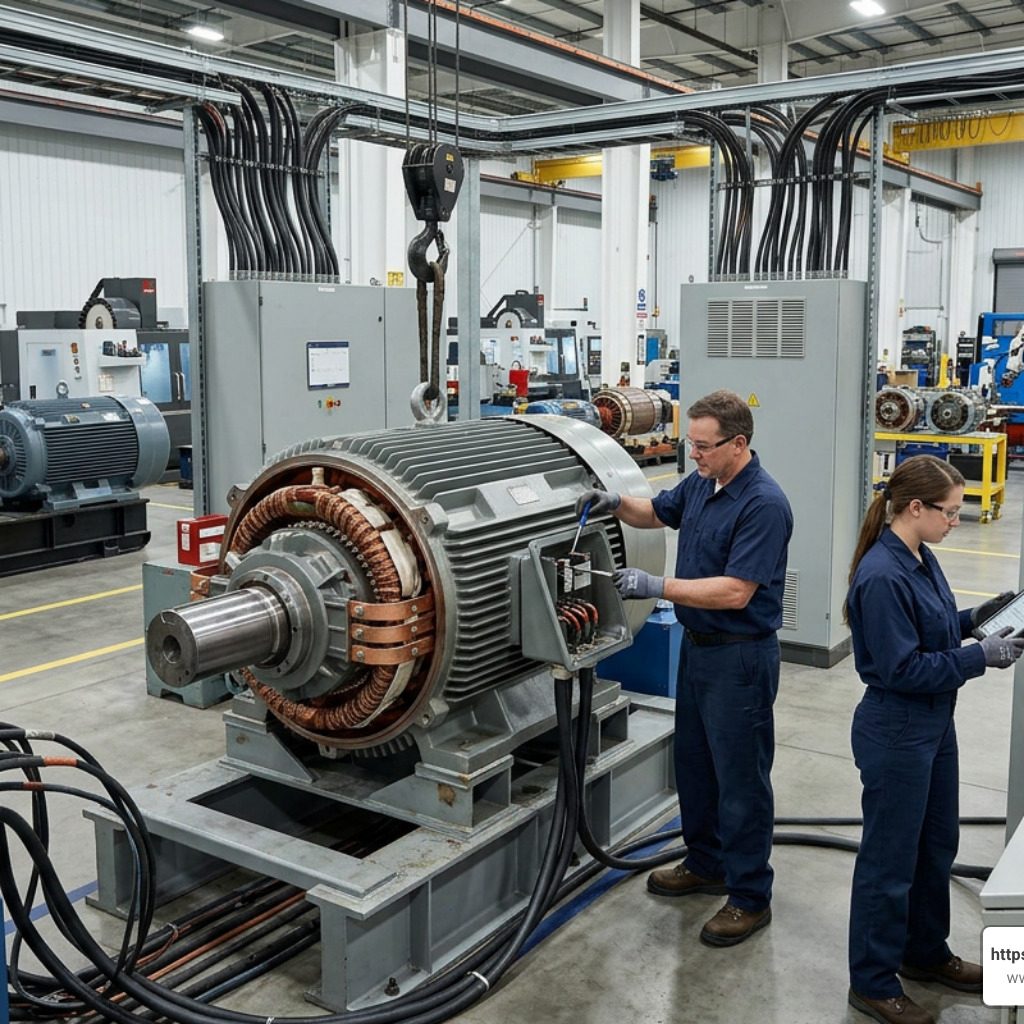
A supplier’s value extends well past product dispatch. Certified motor service facilities provide custom engineering, precision remanufacturing, and dynamic balancing down to tight ISO vibration tolerances. When unexpected winding failure halts production, high-grade repair services restore operation via precision Class H insulation rewinds.
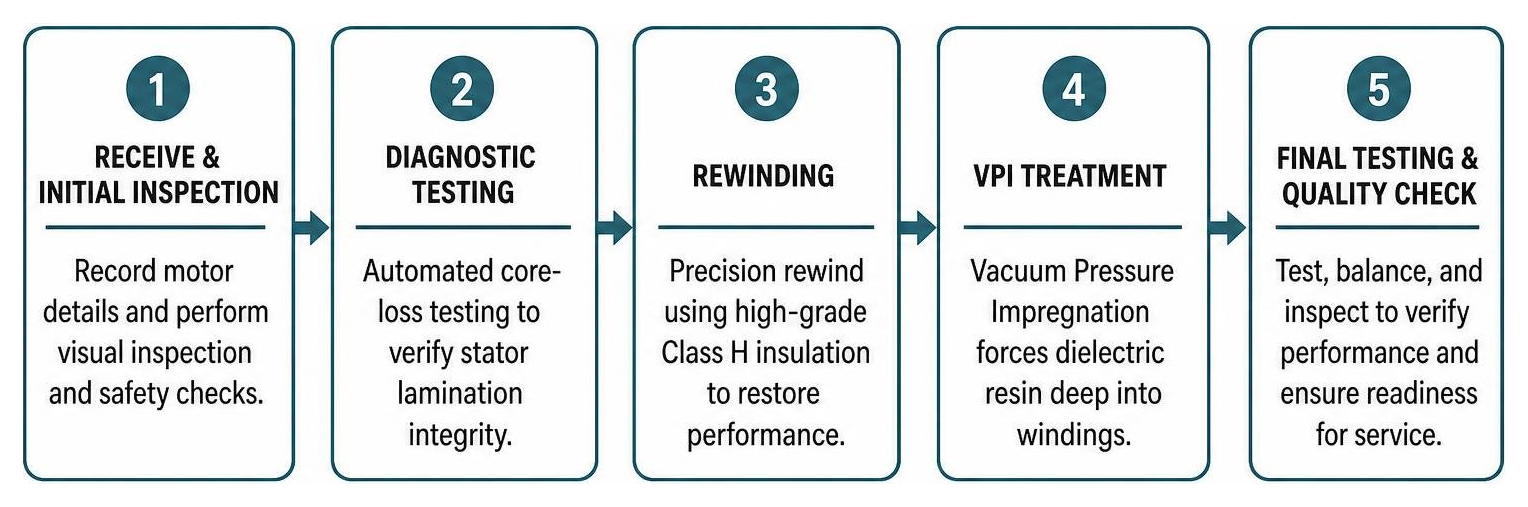
Leading engineering centers utilize automated core-loss testing to verify stator lamination integrity before rewinding. Windings are then treated using Vacuum Pressure Impregnation (VPI) tanks. VPI forces high-grade dielectric resin deep into the winding slots under positive pressure, curing the system into a solid mass that resists moisture, airborne chemicals, and thermal breakdown.
Comparing the 5 Best Categories of Industrial Motor Sourcing Partners
No single vendor model covers every industrial procurement need. Sourcing channels present distinct trade-offs between rapid stock delivery, custom engineering, and specialized certifications.
High-Voltage and Heavy-Duty Electrical Motors Suppliers
Heavy process industries—such as mining, metallurgy, cement production, and municipal water conservancy—rely on medium- and high-voltage drive systems. Specialized manufacturers engineer slip-ring, wound-rotor, and synchronous machines running from 3 kV to 13.8 kV. Advanced heavy-duty facilities operate integrated test fields up to 2,300 kVA to conduct full-load testing and dynamic torque measurements exceeding 30,000 Nm before equipment dispatch. These heavy-duty high-inertia drives power massive ball mills, high-pressure pumps, and air separation compressors.
Precision Motion and Integrated Electrical Motors Suppliers
Modern automation, automated guided vehicles (AGVs), medical devices, and robotic packaging lines require compact, dynamic motion components. Precision suppliers produce integrated stepper and BLDC units that combine the motor, driver, and controller into a single compact housing. Specialty motion manufacturers also supply frameless motors, coreless drives, and precision stators/rotors. These systems incorporate closed-loop encoders (ranging from 1000-line incremental to 17-bit absolute) and integrate with PLCs via industrial fieldbus networks like CANopen, EtherCAT, Modbus, and RS485.
OEM Specialty and Custom Gearmotor Manufacturers
When applications require high starting torque at slow rotational speeds, engineering teams turn to integrated gearmotor specialists. Custom gearmotor manufacturers design matched AC, DC, and brushless gearmotor systems. These units combine precision motors with right-angle worm gearboxes, parallel shaft gearing, or planetary speed reducers. Finding the right gearing setup is critical, as detailed in our guide to low RPM motor options: a buyer’s guide for slow-speed applications, ensuring maximum mechanical advantage for packaging lines, medical conveyors, and precision metering pumps.
Broadline Full-Service Industrial Distributors
Broadline distributors focus on volume, inventory availability, and rapid logistics. Maintaining thousands of active SKUs across low- and medium-voltage ranges (from fractional 1/125 HP units up to 2,000+ HP industrial drivers), these suppliers support fast shipping programs and maintain cross-reference databases for legacy OEM part numbers. Plant managers working with full-line partners for electric motor sales benefit from centralized access to replacement capacitors, motor starters, C-face conversion kits, and direct drop-in units.
Specialized Severe-Duty and Explosion-Proof Vendors
Operating in hazardous chemical refineries, grain processing facilities, and offshore oil platforms requires specialized protection against explosive vapors, gases, and combustible dusts. Severe-duty suppliers engineer motors compliant with IEEE standards, UL, ATEX, and IECEx standards for Class I, Division 1 and Division 2 environments. These motors utilize cast-iron frames, corrosion-resistant hardware, positive-pressure enclosures (such as TZYW and YZYKS series), and flamepath seals. Plant engineers can evaluate application-specific trade-offs by exploring the differences of AC & DC motors across both hazardous and general washdown environments.
Critical Motor Selection and Procurement Criteria for Plant Operations
Selecting an industrial drive requires analyzing mechanical load profiles, thermal conditions, and electrical power supplies to prevent premature winding or bearing failure.
Matching Motor Topology, Speed, and Duty Requirements
Motor selection begins by evaluating whether the driven equipment presents a variable torque load (centrifugal pumps and fans) or a constant torque load (conveyors, extruders, positive displacement pumps). Calculating synchronous speed versus full-load operating RPM—governed by line frequency ($f$) and the number of stator poles ($P$) using the standard formula:
$$RPM = frac{120 times f}{P}$$
determines the correct baseline configuration. When sizing motors for specific production lines, engineers can review mastering AC motor speeds: a practical selection handbook to ensure proper torque delivery across base, synchronous, and slip speeds.
Continuous operation requires motors with an S1 duty cycle and a minimum 1.15 Service Factor (SF), allowing the motor to handle brief overload spikes without exceeding insulation thermal limits.
VFD Integration, Bearing Protection, and Inrush Current Controls
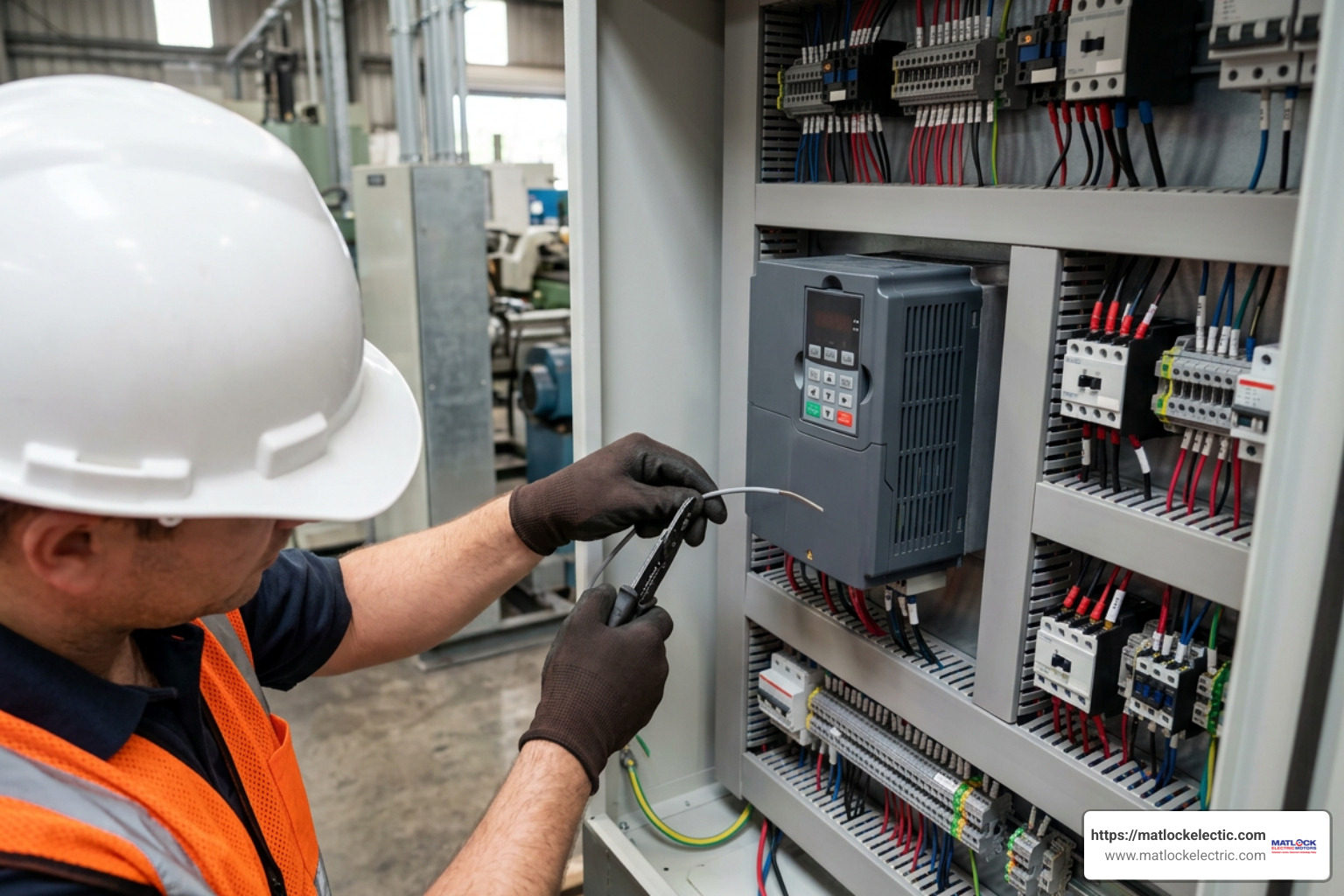
Modern automated processes use Variable Frequency Drives (VFDs) for speed control and energy optimization. However, the fast-switching pulse-width modulation (PWM) inverters in VFDs introduce high-frequency common-mode voltages onto the motor shaft. If left ungrounded, these voltages discharge through the motor bearings to the grounded end-bell, causing electrical discharge machining (EDM) that results in microscopic pitting, frosting, and fluting along the bearing raceways.
Leading motor suppliers mitigate this by installing internal or external Aegis shaft grounding rings, ceramic insulated bearings, and dV/dt load filters. For fixed-speed heavy-inertia loads, suppliers recommend pairing drives with soft starters. You can review the mechanical and electrical benefits in AC motor soft starter mechanics and real-world applications to eliminate severe across-the-line starting current spikes.
Value-Added Services, Maintenance, and Lifecycle Support
Top-tier motor suppliers provide comprehensive lifecycle support to maintain uptime, reduce operational costs, and streamline facility retrofits.
Drop-In Retrofitting, Adapter Bases, and Dynamic Balancing
Replacing obsolete motors with non-standard dimensions often creates significant mechanical mounting challenges. Reworking structural concrete pads or cutting steel bases causes costly operational delays. Full-service suppliers solve this by fabricating custom transition adapter bases. These engineered steel plates match the existing foundation bolt pattern while elevating the new NEMA or IEC motor to the exact legacy shaft centerline height, ensuring precise laser shaft alignment.
Additionally, service centers utilize precision dynamic balancing machines capable of balancing multi-ton rotors at operating speeds. This eliminates residual unbalance, cuts baseline vibration, and protects bearing life.
In-House Testing Protocols and Predictive Maintenance
Routine diagnostics catch insulation degradation before sudden dielectric breakdown occurs. Leading repair and supply centers perform comprehensive electrical validation procedures:
- Insulation Resistance (Megohmmeter): Verifies basic winding ground wall resistance.
- Polarization Index (PI) & Dielectric Absorption (DA): Measures insulation resistance over a 10-minute ratio test to detect internal moisture contamination, oil buildup, or thermal aging.
- Surge Comparison Testing: Injects fast-rising voltage pulses (up to 30 kV on high-voltage machines) to detect turn-to-turn, coil-to-coil, and phase-to-phase shorts that DC tests miss.
- DC HiPot Testing: Stresses ground wall insulation under controlled over-voltage conditions to confirm dielectric withstand capability.
- Servo Feedback Alignment: Specialized facilities handling servo motor repair use diagnostic feedback analyzers to verify encoder, resolver, and Hall-sensor timing before returning units to service.
Frequently Asked Questions About Electrical Motor Procurement
What quality certifications should top industrial motor vendors hold?
Industrial motor manufacturers and distributors should maintain an ISO 9001-2015 certified Quality Management System. Automotive-grade motion suppliers require IATF 16949 certification. For hazardous environments, ensure products carry verified UL, CSA, ATEX, or IECEx listings. Service and remanufacturing centers should comply with Electrical Apparatus Service Association (EASA) AR100 standards.
How do VFDs damage motor bearings, and what solutions do suppliers provide?
VFDs induce capacitive voltages on the motor shaft due to inverter PWM switching. When this voltage exceeds the dielectric breakdown threshold of the bearing grease film, current arcs directly through the steel balls and raceways, causing electrical pitting, fluting, and bearing failure. Suppliers resolve this by installing shaft grounding rings, utilizing insulated ceramic bearings on the non-drive end, and recommending drive-side line reactors or common-mode chokes.
What is the typical lead time difference between stock and custom-engineered motors?
Standard NEMA and IEC off-the-shelf motors (ranging from fractional up to 250 HP) typically ship same-day or within 24 to 48 hours. Custom-modified units (such as specific C-face conversions, special shafts, or thermal sensors) generally take 1 to 2 weeks. Fully engineered custom medium-voltage motors, high-power synchronous machines, or specialized OEM prototypes require 30 to 90 days for design, casting, winding, VPI treatment, and complete load testing.
Conclusion
Choosing the right supply partner is an essential operational strategy to protect production schedules and reduce long-term maintenance costs. Whether you are stocking critical spares, sourcing an immediate replacement for a blown pump motor, or designing high-efficiency automated machinery, partnering with an experienced supplier ensures proper framing, thermal resilience, and electrical compatibility.
Review your operating environment, match enclosure and efficiency classes, and confirm that your supplier provides the diagnostic testing, custom adaptation, and engineering support your plant requires. For broad inventory access, technical support, and complete lifecycle drive solutions, explore our full catalog of industrial electric motors to keep your facility operating at peak performance.