Find Compatible Motor Repair Parts Before You Order
The right motor repair parts match your motor’s nameplate, part number, electrical ratings, frame size, and physical dimensions. Before ordering, record the manufacturer, model, voltage, phase, horsepower, RPM, frame, and any number stamped on the failed component. Then compare those details with the replacement part’s specifications – not just its appearance.
Common replacements include bearings, cooling fans, capacitors, thermal overloads, switches, end bells, couplers, brushes, and brush holders. A close-looking part can still be wrong if its shaft fit, bearing size, capacitor rating, enclosure, or mounting pattern differs.
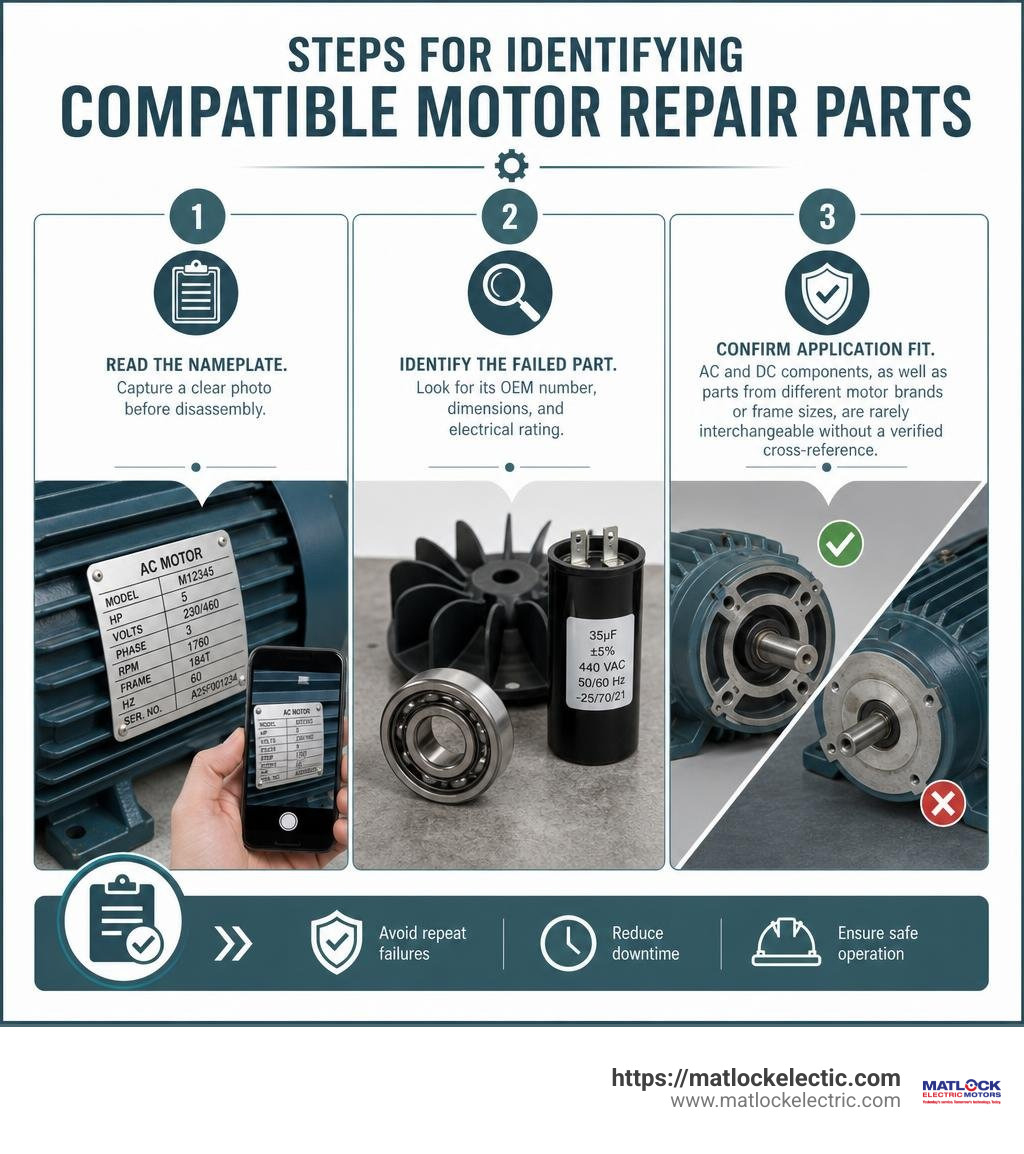
Start with these three checks:
- Read the nameplate. Capture a clear photo before disassembly.
- Identify the failed part. Look for its OEM number, dimensions, and electrical rating.
- Confirm application fit. AC and DC components, as well as parts from different motor brands or frame sizes, are rarely interchangeable without a verified cross-reference.
Getting the match right helps avoid repeat failures, unsafe operation, and unplanned downtime. It also helps you decide when a simple wear-part replacement is practical and when a full repair or replacement motor makes more sense.
Essential Motor Repair Parts for Industrial and Commercial Equipment

When an electric motor stops turning on a production line or commercial HVAC setup, the problem rarely requires throwing away the entire machine. In most facilities, failures stem from a few predictable wear components that undergo continuous mechanical friction or electrical cycling. Having the right replacement hardware on hand keeps downtime minimal and avoids unnecessary equipment turnover.
The internal anatomy of an industrial motor divides into mechanical assemblies and electrical components. On the mechanical side, we look at cooling fans, fan shrouds, drive shafts, and dynamic housings. Electrically, single-phase and direct-current motors depend on starting mechanisms, winding protection, and current-transfer assemblies. Sourcing the right accessories—from conduit boxes and drip covers to encoder kits and replacement brakes—ensures your motor runs within its rated environmental specifications.
Bearings, Bushings, and Housings
Bearings take the brunt of operational loads. Deep groove ball bearings are the industry standard for standard electric motors, but you must select the correct seal type for your operating environment.
- 2RS Bearings: These feature contact rubber seals on both sides, providing superior protection against fine particulate ingress and moisture. They work well in dusty or wet environments, though they carry slightly lower maximum speed limits due to seal friction.
- 2Z Bearings: These utilize non-contact metal shields. They are ideal for high-speed, clean industrial environments where low friction and minimal heat buildup take priority.
Beyond the rolling elements, cast iron or aluminum end bells (end shields) support the rotor shaft and house the bearing cavities. Over years of vibration or belt tension, bearing journals can wear oversize, causing rotor eccentricity. If an end bell bore becomes out of round, our mechanical services team often uses precision sleeve inserts or bearing bracket replacements to restore factory concentricity.
Capacitors, Switches, and Thermal Overloads
Single-phase induction motors lack the rotating magnetic field naturally present in three-phase power, requiring specialized auxiliary circuits to initiate rotation:
- Start Capacitors: Designed for short-duty cycles (rated in higher ranges like 200–400 MFD / 125–250 VAC), these provide the initial phase shift necessary to get the motor up to roughly 75% of its rated speed.
- Run Capacitors: Engineered for continuous duty (typically rated at 5–50 MFD / 370–440 VAC), these optimize running efficiency, torque, and power factor.
- Centrifugal and Stationary Switches: A mechanical governor mounted on the rotor opens stationary contact points once the motor reaches speed, disconnecting the start capacitor. If contacts pit or stick, the start winding can overheat rapidly. Solid-state electronic switches serve this role in harsh or high-cycle setups.
- Thermal Overload Protectors: Components like button-style Klixon switches monitor internal frame temperatures. They trigger an automatic or manual trip when windings exceed safe limits, preventing catastrophic insulation burnouts.
Carbon Brushes, Commutators, and Brush Rigging
Direct current (DC) motors and universal motors rely on sliding electrical contacts. Carbon brushes transfer current directly from stationary wiring into the spinning armature via the commutator bars.
Over continuous duty cycles, brushes erode naturally. They must be inspected for minimum length, chip damage, and uneven face seating. The brush rigging—including brush holders, constant-force tension springs, and slip rings—must maintain consistent downforce. Insufficient spring tension leads to electrical arcing, which damages commutator bars, while excessive force causes premature brush and copper wear. When severe arcing or heavy grooving develops, specialized DC repairs are necessary to re-turn and undercut the commutator mica.
Diagnosing Failure Symptoms and Choosing Replacement Parts

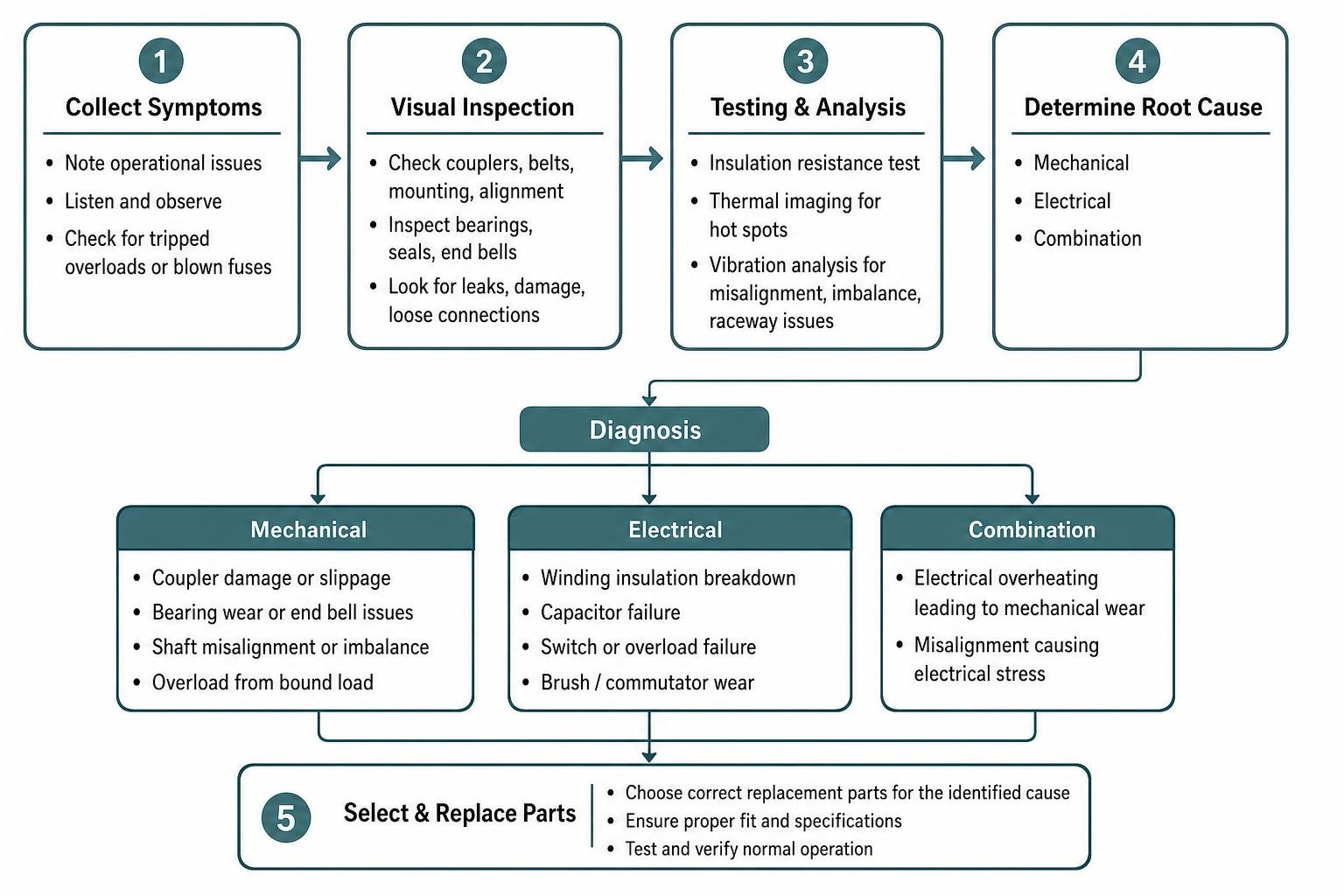
Before ordering hardware, technicians must isolate whether a failure is mechanical, electrical, or a combination of both. Rushing to replace a part without diagnosing the root cause often leads to repeated failures on the new component.
A systematic diagnostic sequence combines physical inspection, thermal imaging, and vibration analysis. Thermal cameras identify localized hot spots around bearing caps or terminal boxes, while vibration analysis reveals misalignments, imbalance, and early raceway spalling. Before pulling a motor off its base, performing baseline insulation checks as outlined in our troubleshooting motors a practical guide to resistance testing helps determine if the windings are electrically sound.
Identifying Mechanical Wear: Couplers, Rotors, and Shafts
Mechanical issues often exhibit distinct physical symptoms before complete failure:
- Sacrificial Motor Couplers: Flexible drive couplers (such as the three-piece jaw couplers or appliance direct-drive couplers like the common 285753A style) act as deliberate mechanical fuses. When a pump or gearbox binds, the coupler snaps to save the motor. If a motor hums and spins freely without driving the load, check for shattered rubber or sheared drive lugs.
- Bent or Scored Shafts: Excessive overhung belt loads or severe machine jams can bend shafts or score the journal surfaces. Operating with a bent shaft quickly destroys new bearings and risks rotor-to-stator contact.
- Dynamic Rotor Unbalance: Dirt accumulation on internal cooling fans or broken rotor bars can cause severe vibration. Comprehensive repair procedures include dynamic balancing to eliminate high-amplitude vibrations that degrade surrounding machinery.
Diagnosing Electrical and Commutator Faults
Electrical faults require electrical testing equipment rather than simple visual checks. Insulation breakdown often starts quietly when heat, moisture, or chemical vapors penetrate winding varnish.
- Winding Ground Faults and Opens: A megohmmeter (megger) applies high DC voltage to evaluate insulation resistance against the motor frame. A low resistance reading indicates degraded insulation that risks a short circuit.
- Burnt Commutator Bars and Arcing: In DC motors, uneven discoloration, blackened bars, or heavy copper dragging indicate brush seating issues, incorrect neutral plane alignment, or shorted armature coils. For step-by-step armature diagnostics, review our guide to DC motor armature resistance diagnosis and bench testing techniques.
Sourcing OEM vs. Aftermarket Motor Repair Parts
When choosing replacement components, maintenance managers weigh OEM (Original Equipment Manufacturer) parts against aftermarket alternatives. Both options have appropriate use cases depending on the application’s criticality.
| Evaluation Metric | OEM Replacement Parts | High-Grade Aftermarket Parts | Low-Cost Generic Parts |
|---|---|---|---|
| Dimensional Accuracy | Exact factory tolerances; drop-in fit | Matched to original NEMA/IEC specs | Variable; may require machining |
| Material Quality | Factory certified; consistent metallurgy | Equivalent polymer or alloy grades | Lower grade plastics or soft steels |
| Warranty Compliance | Maintains original manufacturer warranty | Standard vendor warranty | Limited or no operational warranty |
| Lead Times | Can be long for legacy equipment | Often readily stocked and available | Widely available online |
| Best Application | Critical process lines, extreme environments | General industrial, commercial maintenance | Non-critical, low-duty applications |
AC vs. DC Motor Compatibility and Specialized Drive Components
AC and DC motors convert electrical energy into mechanical rotation using different electromagnetic designs. Because their physical construction and operating dynamics differ, parts between the two are rarely interchangeable. Understanding the core differences of AC DC motors helps avoid ordering incompatible hardware.
AC induction motors rely on a stationary stator winding to create a rotating magnetic field that induces current in a squirrel-cage rotor. They require components like start capacitors, centrifugal switches, and stator cooling fans. In contrast, DC motors use field poles, wound armatures, commutators, and carbon brush rigging to mechanically switch current.
For standard alternating-current infrastructure, our team handles complete AC repairs, while motion-control setups requiring tight feedback loops benefit from dedicated servo motor repair services that address optical encoders, resolvers, and specialized braking mechanisms.
Decoding Motor Nameplates and Frame Specifications
The motor nameplate is the most reliable guide for sourcing replacement parts. It outlines the physical, mechanical, and electrical constraints established by standards organizations such as NEMA (National Electrical Manufacturers Association) in North America or IEC (International Electrotechnical Commission) globally.
- Frame Size (e.g., NEMA 56, 145T, 215T): Frame numbers dictate critical physical dimensions. The first digits define the shaft center-to-base height (the “D” dimension), while suffix letters define shaft diameter, length, and mounting flange configurations (such as “C” for C-face mounts or “T” for modern integral horsepower dimensions).
- Duty Cycle and Service Factor (SF): Indicates whether the motor is rated for continuous duty (CONT) or intermittent operation, and how much overload capacity it can safely handle (e.g., an SF of 1.15 allows a 15% temporary power margin).
- Insulation Class (B, F, H): Dictates the maximum operating temperature the winding insulation can endure without degrading. Replacement internal thermal switches must align with this thermal envelope.
Specialized Replacement Parts for Industrial and Heavy Equipment
Certain drive systems use specialized internal components that go beyond standard ball bearings and capacitors:
- eBike and Light EV Drive Units: Mid-drive electric bike motors from manufacturers like Bosch, Brose, and Yamaha integrate miniature planetary reduction gears, internal torque sensors, sprag one-way clutch bearings, and precision crankshaft seals. Rebuilding these units requires specialized chainring spider lockring tools and low-pressure synthetic lubricants to protect sensitive sprag clutches.
- Heavy-Duty Commercial Equipment: Industrial diesel engines and engine-driven auxiliary motors require comprehensive rebuild packages. An in-frame overhaul kit, for example, combines cylinder liners, pistons, rings, thrust plates, and main journal bearings to rebuild equipment in-chassis.
- Marine Direct-Drive and Waterfront Lifts: Waterfront motors require marine-grade enclosures (NEMA 4X or sealed DC housings), corrosion-resistant internal gears, and specialized pendant control switches designed to withstand prolonged UV exposure and saltwater spray.
Step-by-Step Part Replacement, Safety Precautions, and Maintenance
Servicing electric motors requires strict adherence to mechanical and electrical safety protocols. Before handling components, always observe these core practices:
- Lockout/Tagout (LOTO): Disconnect, lock, and tag all upstream electrical feeds to prevent accidental startup.
- Capacitor Discharge: Never touch capacitor terminals with bare hands. Use a high-wattage resistor (e.g., a 20,000-ohm, 5-watt resistor held with insulated pliers) across the terminals to safely bleed off stored high-voltage charges.
- PPE Protocols: Wear cut-resistant gloves, safety glasses with side shields, and steel-toe footwear throughout disassembly and reassembly.
Tools and Procedures for Mechanical Teardowns
Using proper mechanical tools prevents damaging fragile components during teardowns:
- Bearing Extraction: Never use a hammer directly on a shaft or bearing race. Use a mechanical 2-jaw or 3-jaw puller applied exclusively against the inner race to avoid shearing shaft shoulders. When installing new bearings, use an induction bearing heater or a mechanical press sleeve that pushes solely against the press-fit race.
- End Bell Alignment: When reseating end bells onto the motor stator frame, tighten bolts gradually in a cross-star pattern while spinning the shaft by hand. If the shaft begins binding, the end bell is seating unevenly, which can pinch the bearing outer race.
- Specialized Drive Tools: Specialized assemblies like mid-drive motors require dedicated spider sockets and low-torque screwdrivers (often calibrated around 0.2–2.0 Nm) to avoid stripping lightweight magnesium or aluminum alloy threads.
Locating Obsolete or Hard-to-Find Motor Repair Parts
When servicing older equipment, you may encounter discontinued models where OEM replacement parts are no longer manufactured. In these scenarios, complete equipment replacement is not your only option:
- Transition Bases: If a modern motor frame does not match an obsolete mounting pattern, heavy-gauge steel transition bases allow newer NEMA frame sizes (such as adapting a 143/145T motor into an older 182/184 footprint) without modifying foundation steelwork.
- Custom Machining and Dynamic Sleeving: Machine shops can weld and re-turn worn shaft journals, bore and sleeve oversized bearing pockets, or fabricate custom shaft keys.
- Precision Stator Rewinding: When obsolete stators suffer electrical shorts, stripping the core, dipping it in Class H insulating resin, and precision rewinding can restore or exceed original operating specs.
- Recertified Motors: When repair lead times would cause costly downtime, our team can source drop-in replacements through our comprehensive inventory of new and reconditioned units at electric motor sales.
Frequently Asked Questions About Motor Repairs
How do I know if my motor needs a new capacitor or a full replacement?
If a single-phase motor hums, trips its breaker on startup, or requires a manual spin of the shaft to start rotating, a failing start capacitor is often the cause.
To confirm, visually inspect the capacitor for oil leakage, a bulged top terminal cap, or a burnt smell. Next, use a digital multimeter with a capacitance (MFD/µF) testing function. Discharge the capacitor safely, disconnect one lead, and test the microfarad reading. If the measured value falls more than 5% to 10% below the rating printed on the casing, replacing the capacitor will typically restore proper motor operation without requiring a full motor replacement.
Are AC and DC motor replacement parts interchangeable?
No. AC and DC motors operate on fundamentally different electrical and mechanical principles.
While some standard deep-groove ball bearings might share physical dimensions across both motor types, internal operational parts cannot be swapped. AC induction motors use cast squirrel-cage or wound rotors and run on alternating current, whereas DC motors require segmented copper commutators, brush holders, and carbon brushes to physically switch polarity. Using an AC component in a DC drive circuit—or vice versa—can cause short circuits, insulation breakdown, or mechanical damage.
What is the most common cause of motor bearing failure?
Lubrication issues cause the majority of early rolling-element bearing failures in electric motors. This includes both insufficient lubrication and excessive over-greasing.
Over-greasing causes high internal churning friction, which increases heat, degrades bearing seals, and can force grease into the motor windings. Other common contributors include airborne particulate ingress, shaft misalignment, belt over-tensioning, and electrical fluting—where stray shaft currents arc through the bearing lubricant film, creating washboard-like ridges across the raceways.
Conclusion
Sourcing the right motor repair parts is one of the most effective ways to lower operational costs, extend machine life, and prevent unplanned downtime. By decoding nameplate data, identifying mechanical wear early, and choosing properly rated components, maintenance teams can keep critical systems running reliably.
Whether you need replacement bearings, capacitors, custom machining, or full rewind services, working with experienced technicians ensures your repairs are completed safely and to original factory specifications. Explore our full range of industrial electric motors and repair capabilities to keep your facility operating at peak performance.