Reliable Electric Motor Repair Starts With the Right Diagnosis
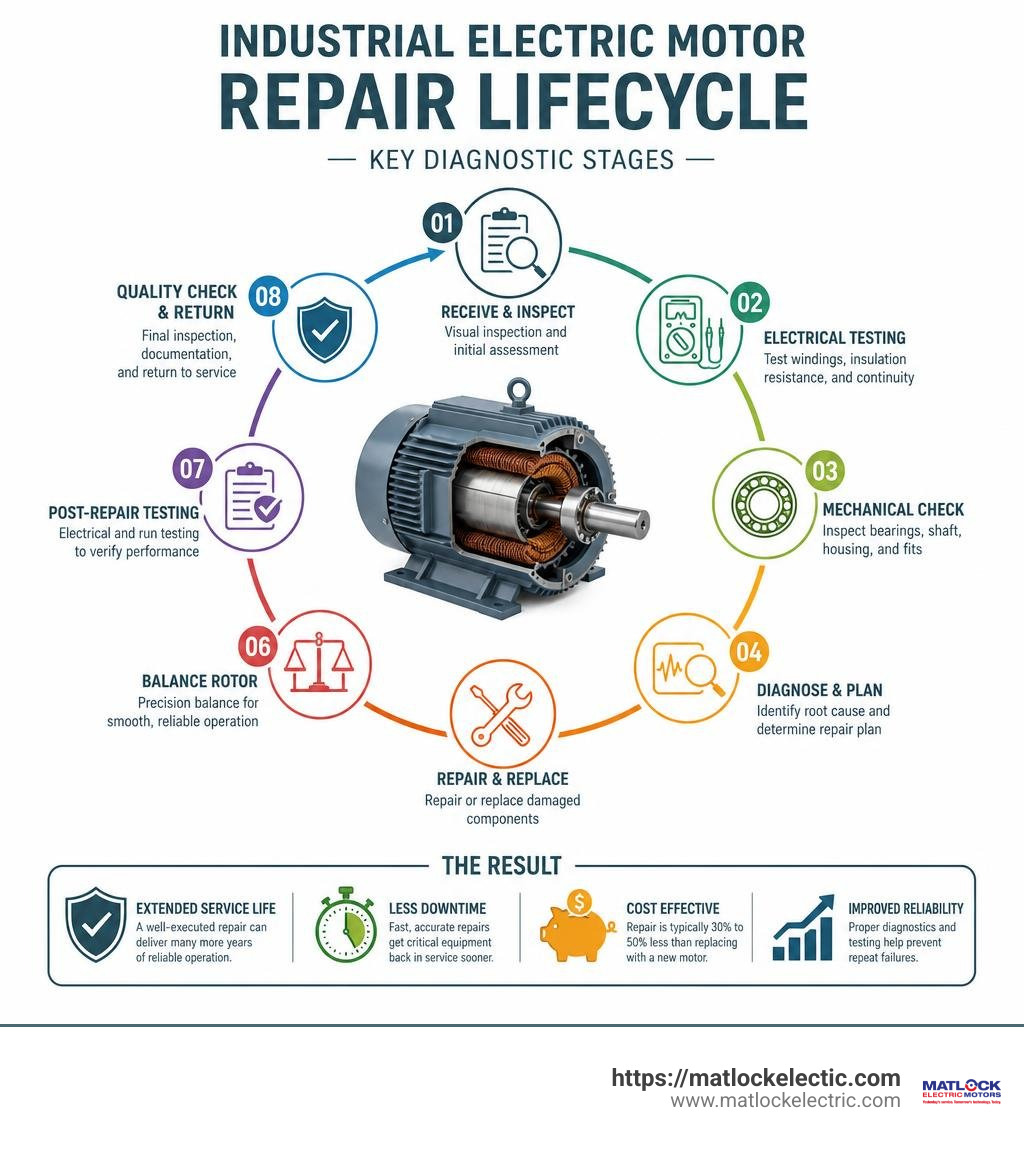
Reliable electric motor repair starts by finding the real cause of failure before replacing parts or rewinding the motor. A qualified service process should inspect the motor, test its windings and insulation, check bearings and shaft fits, repair damaged components, balance the rotor, and confirm performance with post-repair electrical and run testing.
For plant teams, this matters because many motor failures are repairable. Bearing problems account for about 35% of failures, while winding insulation issues account for roughly 30%. Addressing those causes early can prevent a small issue from becoming an unplanned shutdown.
A well-executed repair can also be a practical alternative to replacement. Repair commonly costs 30% to 50% less than a comparable new motor, preserves the existing mounting and coupling fit, and can return a critical asset to service faster than sourcing a specialized replacement. With sound repair practices and routine maintenance, a rebuilt motor may provide 15 to 20 more years of service.
This guide explains how industrial motor repair works, when a rewind makes sense, what testing matters, and how predictive field service can help avoid the next failure.
Core Causes of Failure in Industrial Electric Motors
Electric motors are the workhorses of modern industry, but they operate under constant mechanical, electrical, thermal, and environmental stress. Understanding why motors break down is essential for preventing repeat issues. While catastrophic failures often look sudden, they are usually the result of long-term, progressive degradation.
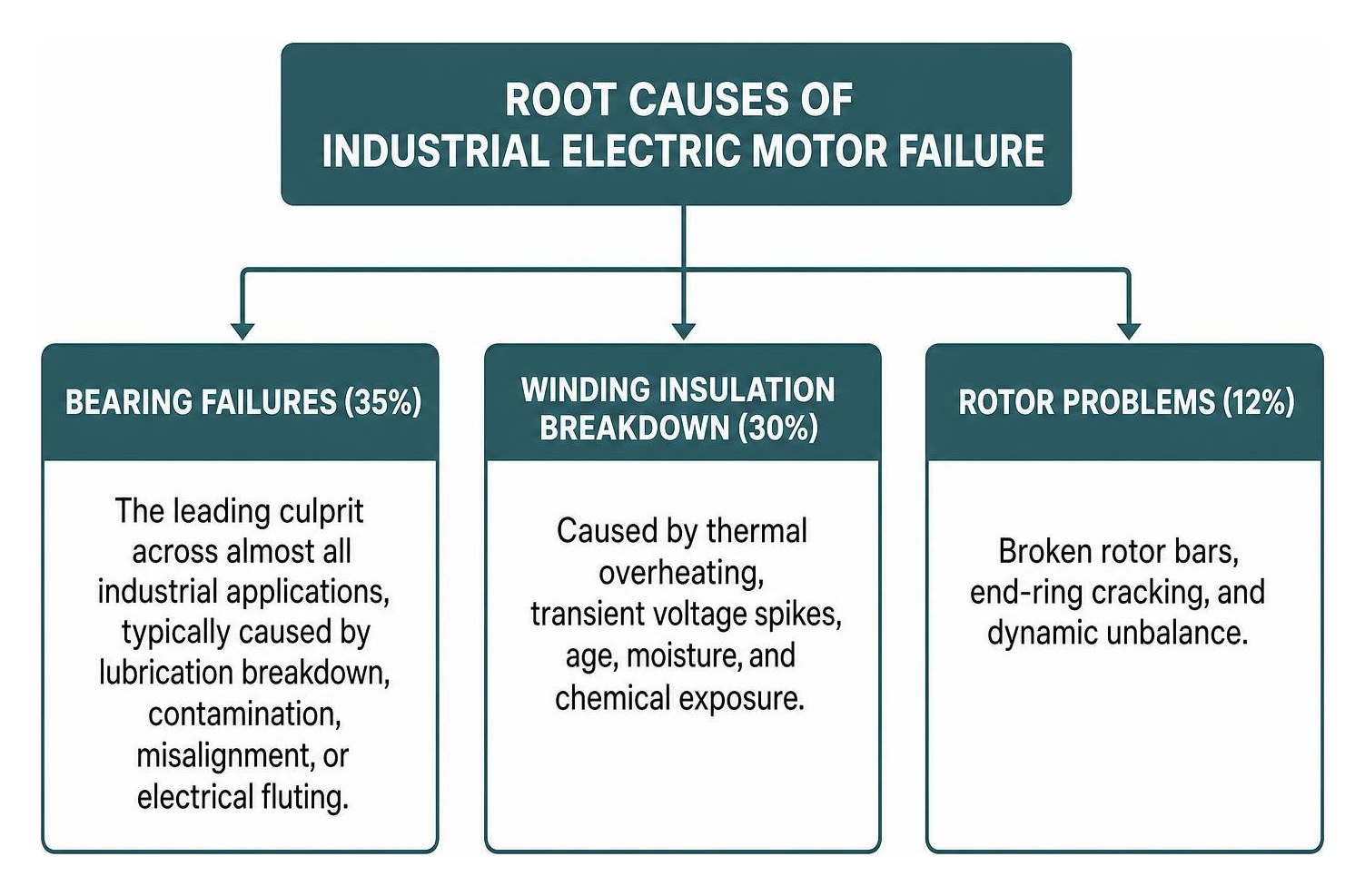
Industry data highlights how vulnerabilities are distributed across standard industrial equipment:
- Bearing Failures (35%): The leading culprit across almost all industrial applications, typically caused by lubrication breakdown, contamination, misalignment, or electrical fluting.
- Winding Insulation Breakdown (30%): Caused by thermal overheating, transient voltage spikes, age, moisture, and chemical exposure.
- Rotor Problems (12%): Broken rotor bars, end-ring cracking, and dynamic unbalance.
- Shaft & Mechanical Issues (10%): Bent shafts, worn keyways, cracked end bells, and housing fretting, all of which require comprehensive mechanical services to restore.
- Contamination (8%): Ingress of dirt, dust, water, process chemicals, and particulate matter into the motor enclosure.
- Other External Factors (5%): Power quality anomalies, phase unbalance, improper mounting, and extreme load swings.
Mechanical Failures and Bearing Wear
Because mechanical components absorb heavy loads, bearings are vulnerable to premature wear. One major mechanical issue is improper lubrication—either applying too little grease, using incompatible lubricants, or over-greasing (which blows out bearing seals and forces grease directly into the stator windings).
Another modern mechanical challenge involves Variable Frequency Drives (VFDs). While VFDs optimize process speeds, they induce common-mode voltages along the motor shaft. When these voltages exceed the dielectric threshold of the bearing lubricant, they discharge through the bearings to ground. This electrical discharge machining (EDM) creates micro-pitting, frosting, and distinctive washboard ridges known as “fluting,” resulting in excessive noise, intense heat, and rapid bearing destruction.
Mitigating these issues requires installing shaft grounding rings, utilizing insulated ceramic bearings on the non-drive end, applying precision laser alignment during installation, and running routine dynamic vibration analysis.
Winding Insulation Breakdown and Electrical Stress
Stator winding insulation isolates individual copper conductors from each other and from the grounded stator core. Over time, thermal cycling degrades this dielectric barrier. For every 10°C increase in operating temperature above an insulation system’s thermal rating, its operational lifespan is cut in half.
In addition to thermal stress, transient voltage spikes from VFD fast-switching IGBTs produce steep-fronted voltage waves ($dV/dt$), stressing turn-to-turn insulation and causing partial discharge or phase-to-phase shorts. Identifying early insulation degradation before total phase grounding occurs relies on targeted electrical diagnostics, such as troubleshooting motor resistance testing.
The Step-by-Step Electric Motor Repair Process
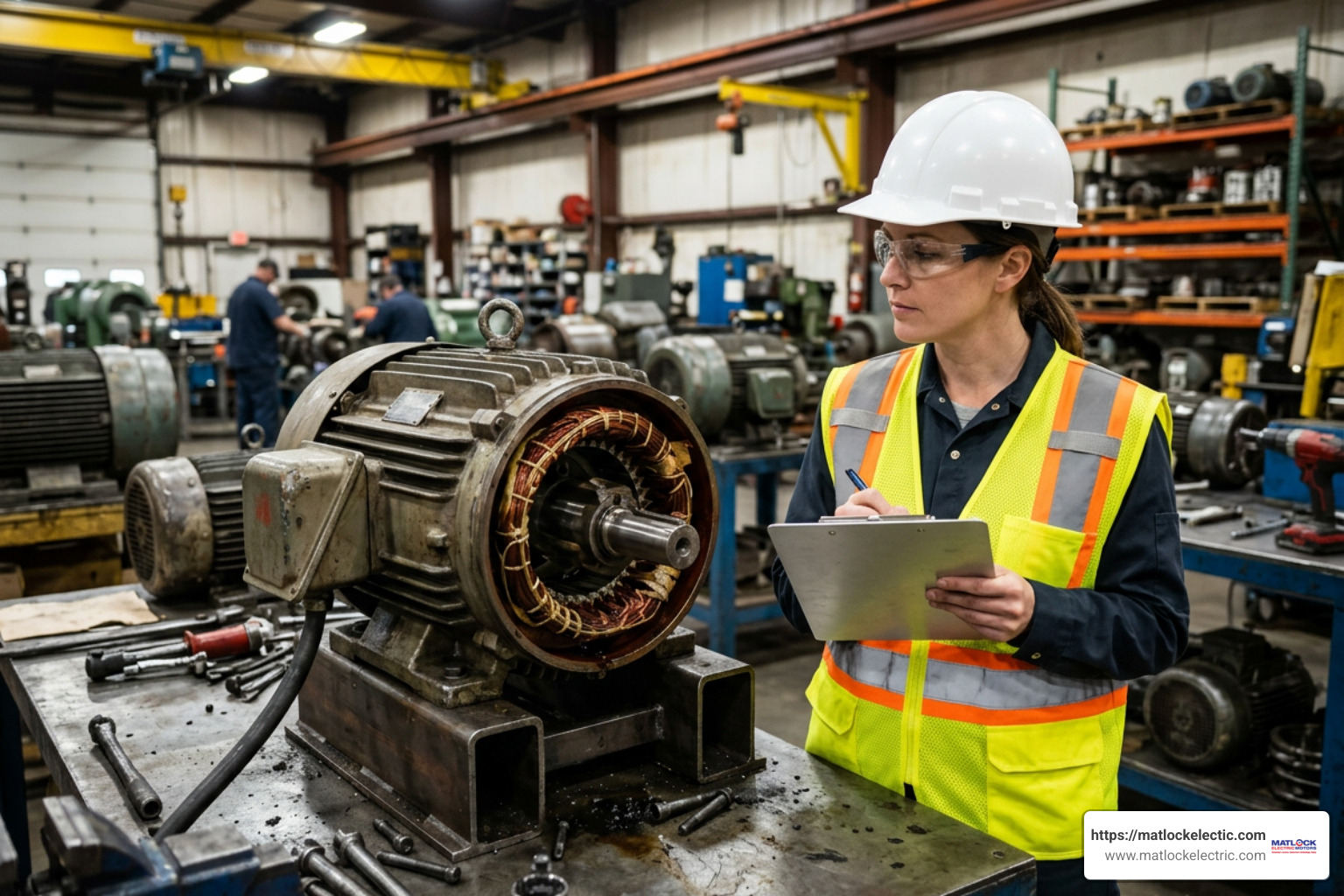
A dependable motor repair facility does not simply swap parts. It follows a structured, documented workflow designed to return the asset to its original operating specifications.
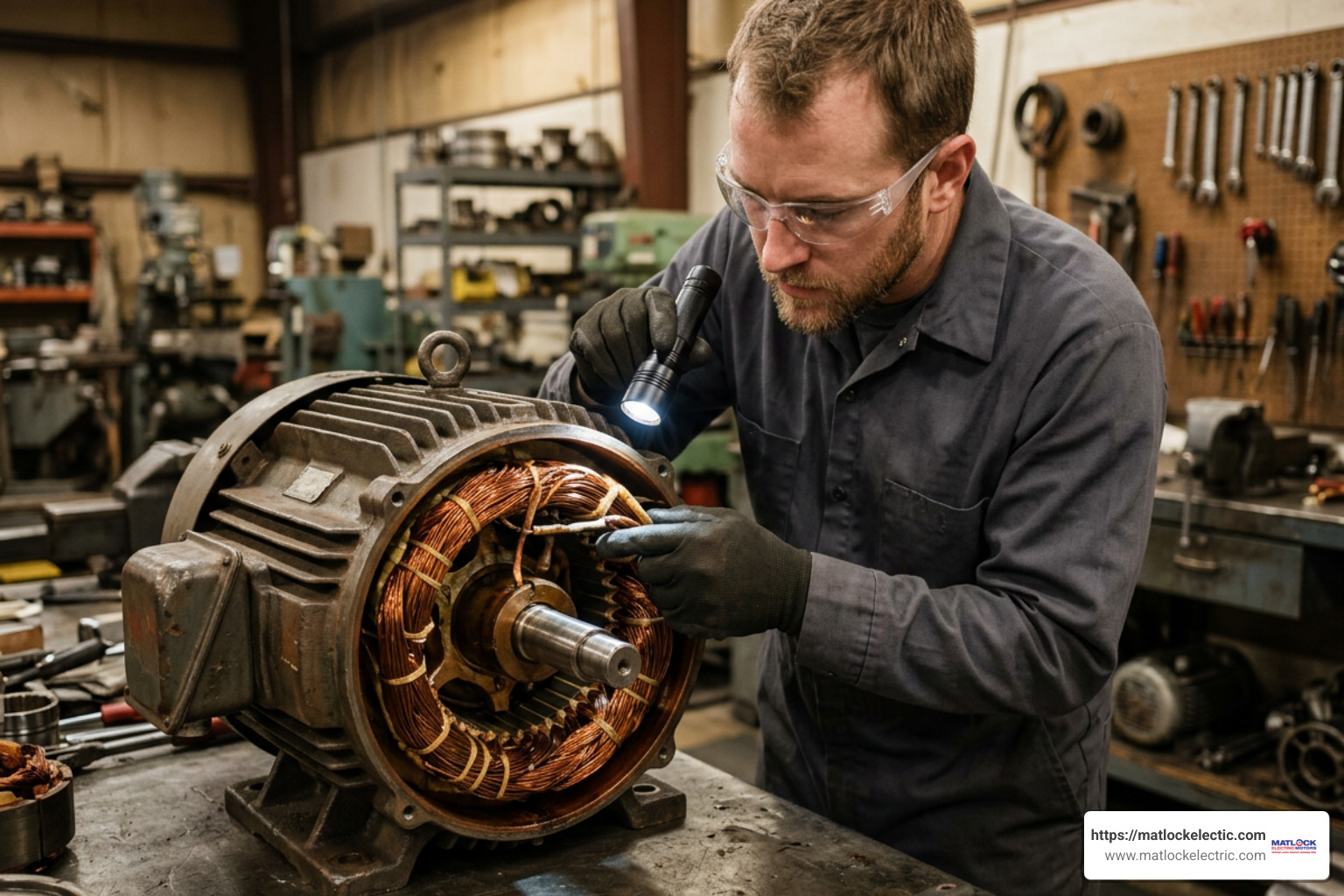
When performing standard industrial AC repairs, adhering to rigid shop floor procedures prevents post-repair performance degradation.
Initial Diagnostics and Teardown Protocols in Electric Motor Repair
Every incoming motor should undergo an intake protocol:
- Documentation & Visual Inspection: Technicians record full nameplate data (horsepower, RPM, voltage, frame size, amperage) and photograph the motor from at least four angles. Keyways, leads, terminal boxes, and mounting feet are checked for physical damage.
- Match-Marking & Baseline Checks: End bells, fan covers, and drive configurations are match-marked. The shaft is spun by hand to evaluate roughness, followed by baseline insulation resistance testing.
- Teardown Diagnostics: Components are disassembled using dedicated bearing pullers and hydraulic presses. Stator windings undergo Surge Comparison analysis, Polarization Index (P.I.) tests, and Step Voltage/Hi-Pot diagnostics.
- Dimensional Verification: Micrometers measure shaft journals and housing bores against ISO 286-2 tolerance fits (such as J6 or K6 interference levels) to ensure bearings seat properly.
Precision Stator Rewinding: Random-Wound vs. Form-Wound Coils
When electrical diagnostics indicate compromised insulation, a complete rewind is necessary. The process differs based on motor size and operating voltage:
- Random-Wound Stators: Typically found in low-voltage motors (under 600V) and smaller horsepower applications. Round, inverter-duty copper magnet wire is inserted into insulated stator slots.
- Form-Wound Stators: Standard for medium- and high-voltage motors (2,300V to 13,800V) and large horsepower applications. Coils are pre-shaped from rectangular copper wire, individually wrapped with mica tape, and fitted into open stator slots.
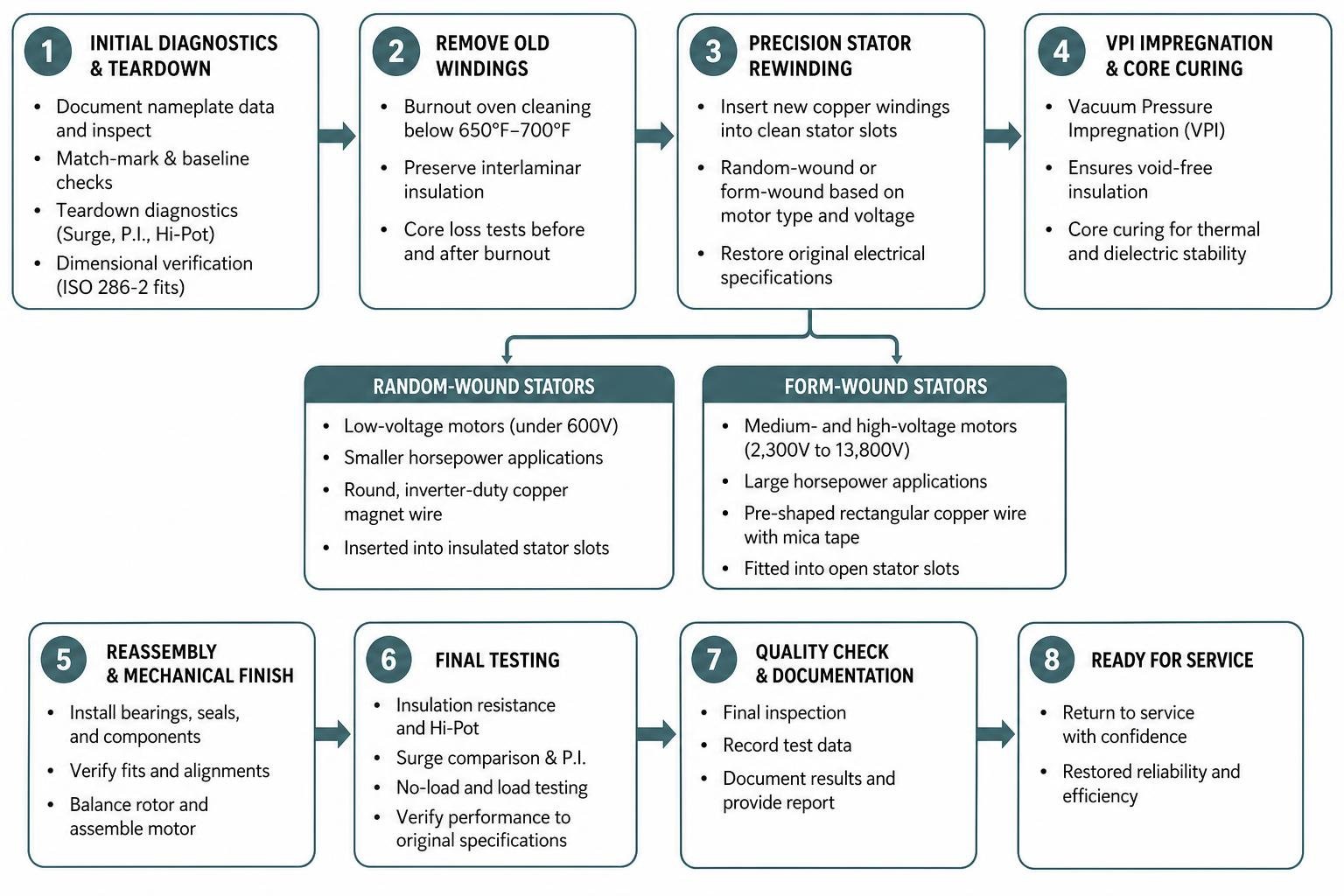
Before inserting new copper, the old windings must be removed without damaging the stator core. Motors are placed in temperature-controlled burnout ovens operating below critical thresholds (never exceeding 650°F–700°F) to cleanly burn off old varnish without compromising the interlaminar insulation of the silicon steel core sheets.
Technicians run core loss tests before and after burnout. Damaged laminations increase magnetic core losses, degrading efficiency. For DC apparatus, specialized DC motor armature diagnostics are conducted to inspect commutators and armature coils before rewinding.
Advanced Vacuum Pressure Impregnation (VPI) and Core Curing
Once the new coils are laced, connected, and insulated with Class H or Class F materials, the stator undergoes resin impregnation. While smaller, standard motors may utilize a dip-and-bake tank, critical and high-voltage apparatus require Vacuum Pressure Impregnation (VPI).
The stator is lowered into a sealed pressure vessel. A deep vacuum pulls air and moisture out of every microscopic void between the copper wire strands. High-grade dielectric resin is introduced to submerge the core, followed by positive pressure pushing the resin into every winding crevice.
The motor is then transferred to an oven to cure at temperatures managed below 270°F. The result is a void-free, monolithic insulation structure that offers heat dissipation, mechanical strength, and resistance against moisture, dust, and chemicals.
Rotor Balancing, Reassembly, and Post-Repair Load Testing
Mechanical balance is necessary for motor longevity. Rotors, cooling fans, and shafts are placed on dynamic balancing machines and balanced to ISO 1940-1 Grade G 2.5 or G 1.0 standards. For severe-duty petroleum or chemical environments, residual unbalance is checked against API 541 requirements.
Reassembly includes installing new OEM-spec bearings, dynamic seals, and calibrated hardware. The motor is then mounted on a machined, vibration-isolated steel bedplate for full-voltage running tests. Technicians measure no-load amperage, phase balance, winding temperature rise, and vibration spectrum across horizontal, vertical, and axial planes to ensure the unit runs smoothly.
Repair vs. Replace: Economic and Operational Decision Factors
Faced with a failed industrial motor, maintenance managers must weigh the cost, turnaround time, and operational impact of repairing versus buying a new replacement.
| Factor | Electric Motor Repair / Rewind | Buying a New Motor |
|---|---|---|
| Typical Cost | 30% to 50% of replacement cost | 100% list price plus shipping |
| Lead Time | Often 3 to 7 business days (24/7 rush available) | Immediate for small stock; weeks/months for custom/large |
| Mechanical Fit | 100% exact match to original base and shaft | May require baseplates, shims, or coupling modifications |
| Lifespan | 15 to 20 years with proper maintenance | 15 to 20+ years |
| Accounting | Immediate operating expense (OpEx) tax write-off | Capital expenditure (CapEx) depreciated over years |
| Efficiency Impact | Retains original efficiency when repaired to EASA standards | Meets current NEMA Premium / IE3 / IE4 standards |
Total Cost of Ownership and the 65% Rule
A standard rule of thumb in plant reliability management is the 65% Rule: if the cost of a complete precision repair exceeds 65% of the purchase price of a modern, energy-efficient replacement, purchasing a new motor is often the better economic choice.
However, motor size heavily shifts this equation:
- Small Motors (< 15 HP): Standard off-the-shelf motors are readily available commodity items. The labor cost to rewind often exceeds 65% of a new unit’s cost, making direct replacement economical.
- Mid-Range Motors (20 to 100 HP): Repair typically costs 40% to 50% of new, saving several thousand dollars while preserving lead time.
- Large / Medium-Voltage Motors (100+ HP to 5,000+ HP): Replacing a 250 HP or 4,160V motor can cost $30,000 to over $100,000 with months of lead time. A precision overhaul or rewind can often be completed for $8,000 to $15,000—saving more than $20,000 and cutting weeks off production downtime.
When new units are required, facilities can look to purchasing new electric motors tailored to high-efficiency operational demands.
Turnaround Time and Custom Mounting Constraints
Cost is not the only factor; downtime costs can exceed thousands of dollars per hour. Sourcing an exact drop-in replacement for obsolete NEMA frames, custom shaft lengths, specific flange mounts (such as D-flange or C-face), or non-standard metric configurations can take weeks or months.
Installing a modern replacement with different physical dimensions often requires engineering modifications, including custom transition baseplates, redrilling concrete foundations, and re-machining shaft couplings. Precision electric motor repair preserves the existing footprint, allowing the motor to drop straight back into place without installation delays.
Selecting an EASA-Accredited Motor Service Provider
Not all service centers use the same equipment, processes, or quality checks. Entrusting a critical industrial motor to an uncertified shop can result in higher core losses, reduced efficiency, and early operational failure.
A study tracking rewound motors found that shops using improper burnout temperatures and substandard winding techniques saw core losses average 32% higher than normal. That 18% increase in total losses caused a 1.5% to 2.5% drop in full-load operating efficiency. Over years of continuous operation, that efficiency loss can outweigh the initial repair savings in electricity bills alone.
The Value of EASA Accreditation and Rigorous Standards in Electric Motor Repair
The Electrical Apparatus Service Association (EASA) established the ANSI/EASA AR100 standard: Recommended Practice for the Repair of Rotating Electrical Apparatus.
Service centers maintaining accreditation undergo independent, third-party audits confirming compliance with dozens of mandatory engineering criteria. Choosing an accredited facility ensures:
- Burnout ovens operate with strict, documented temperature limits to protect core lamination integrity.
- New windings match or exceed OEM copper cross-sectional area and thermal insulation ratings.
- Dynamic balancing, machining tolerances, and bearing fit checks match strict ISO and API engineering specifications.
- All electrical test instruments undergo annual, NIST-traceable calibration.
- Root Cause Failure Analysis (RCFA) is performed to diagnose why the motor failed, preventing identical failures.
Facilities such as our certified EASA service center qualifications ensure that every repaired motor leaves the shop meeting or exceeding original manufacturer specifications.
On-Site Field Services and Predictive Maintenance Integration
The most effective repair strategy is catching problems before a motor burns out. Integrating regular shop capabilities with on-site predictive maintenance bridges the gap between reactive repairs and maximum equipment uptime.
A comprehensive predictive maintenance plan shifts plant operations away from emergency scrambles through proactive plant maintenance strategies. Utilizing dedicated predictive field services gives maintenance managers visibility into asset health via:
- Vibration Spectrum Analysis: Identifies bearing degradation, dynamic unbalance, and mechanical looseness weeks before physical damage occurs.
- Infrared Thermography: Detects loose electrical connections, phase imbalances, and localized thermal hot-spots utilizing advanced diagnostic thermal imaging technology.
- Motor Circuit Analysis (MCA): Evaluates winding resistance, phase balance, and turn-to-turn capacitance directly from the motor control center (MCC).
- Laser Alignment & Dynamic Balancing: Corrects angular and parallel offset on-site to reduce bearing and seal loads.
Frequently Asked Questions About Electric Motor Services
How long does an industrial electric motor repair typically take?
Standard shop repairs—such as bearing replacements, dynamic balancing, dynamic testing, and mechanical cleanup—typically take 1 to 3 business days. Complete stator rewinds for low-voltage, random-wound motors usually require 3 to 7 business days. Large, medium-voltage form-wound motors requiring custom-ordered copper coils and complete VPI processing can take 7 to 14 business days. Most qualified industrial repair facilities offer 24/7 emergency rush services to complete critical repairs around the clock.
Does rewinding an electric motor decrease its operating efficiency?
Not when performed by an EASA-accredited service center following ANSI/EASA AR100 guidelines. In the past, shops operating uncontrolled burnout ovens degraded stator core laminations, causing a 1% to 2% loss in motor efficiency. Modern accredited facilities use temperature-controlled burnout ovens, premium inverter-duty copper wire, and modern resin systems. These methods maintain original efficiency ratings, and can sometimes improve them through optimized winding configurations.
When should an electric motor be replaced instead of repaired?
An electric motor should typically be replaced when:
- The estimated repair cost exceeds 65% of the cost of a new, high-efficiency motor (common for standard motors under 15–20 HP).
- The stator core laminations have suffered severe physical or thermal melting damage that cannot be restored through restacking.
- The motor is an older, standard-efficiency design operating continuously (8,000+ hours/year), where upgrading to a modern NEMA Premium efficiency model yields energy savings with a short payback period.
- Direct, exact-match replacements are available in stock for immediate installation.
Conclusion
Industrial electric motors power your production lines, pumps, compressors, and material handling systems. When a motor fails, making the right call between precision repair and unit replacement determines how quickly your facility resumes operation—and how reliably it runs over the long haul.
By understanding the root causes of motor failure, following structured diagnostic and rewinding processes, and partnering with an accredited service center, you can protect your plant from repeated downtime. Whether you need an emergency rewind, mechanical machining, or on-site predictive vibration monitoring, our team delivers the engineering precision required to keep your business running smoothly.
Contact our team today to explore expert electric motor repair and maintenance solutions designed to optimize your equipment lifecycle and protect your bottom line.