Why ANSI/EASA AR100 Matters for Motor Repair Quality
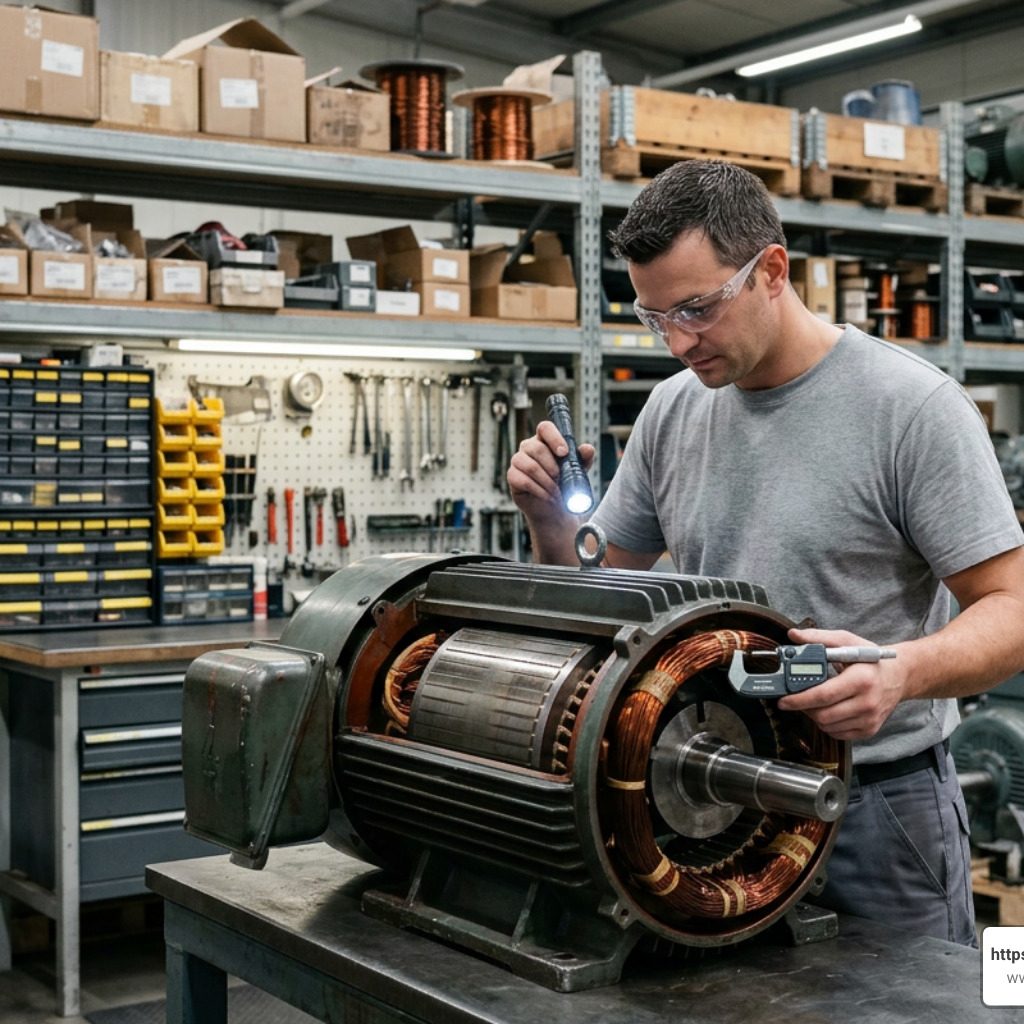
ANSI/EASA AR100 is the American National Standard for repairing rotating electrical apparatus, including AC motors, DC machines, and generators. It gives repair teams a shared set of recommended practices for inspection, rewinding, mechanical repair, and electrical testing so a repaired machine can return to service with dependable performance and without avoidable efficiency loss.
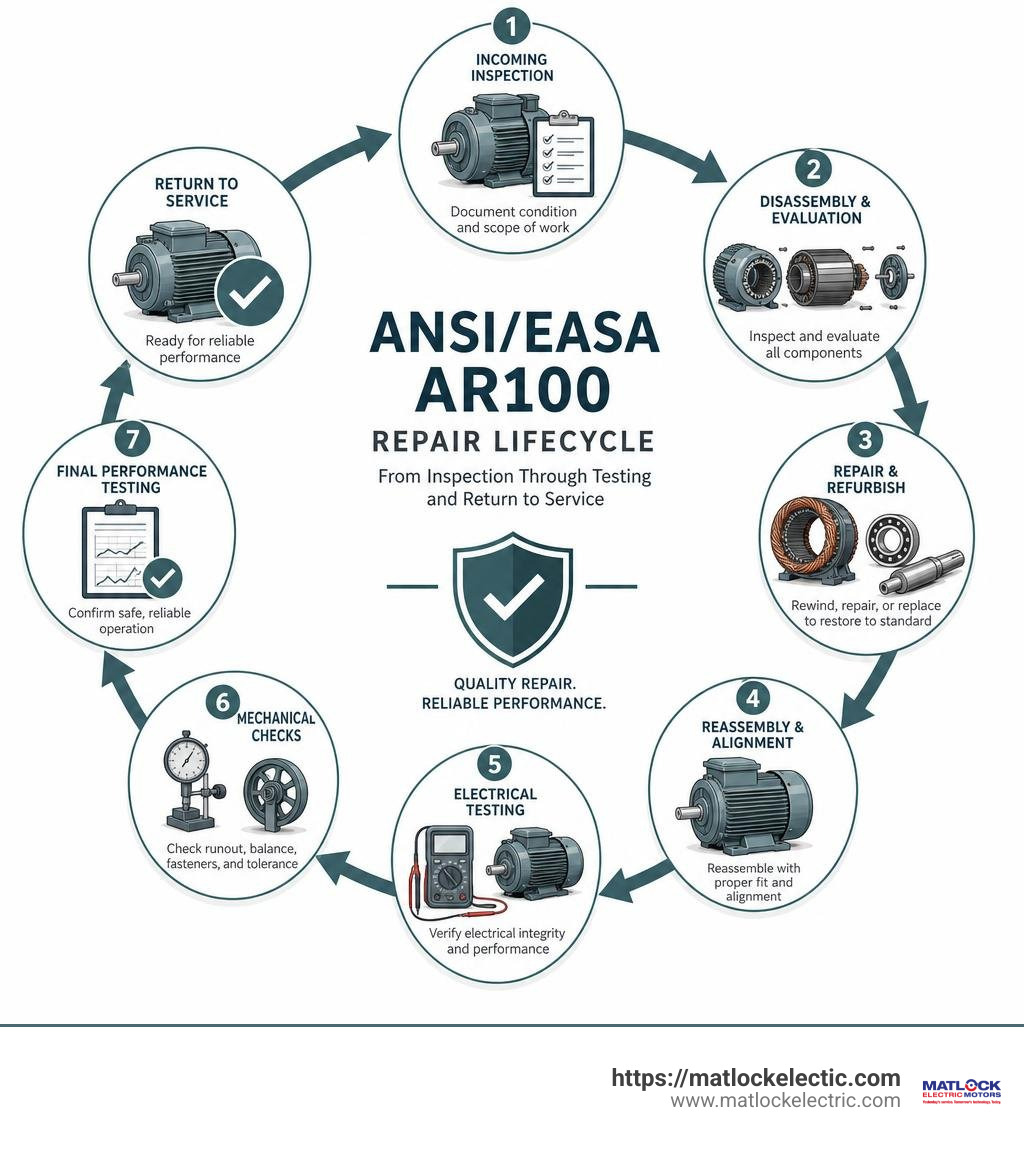
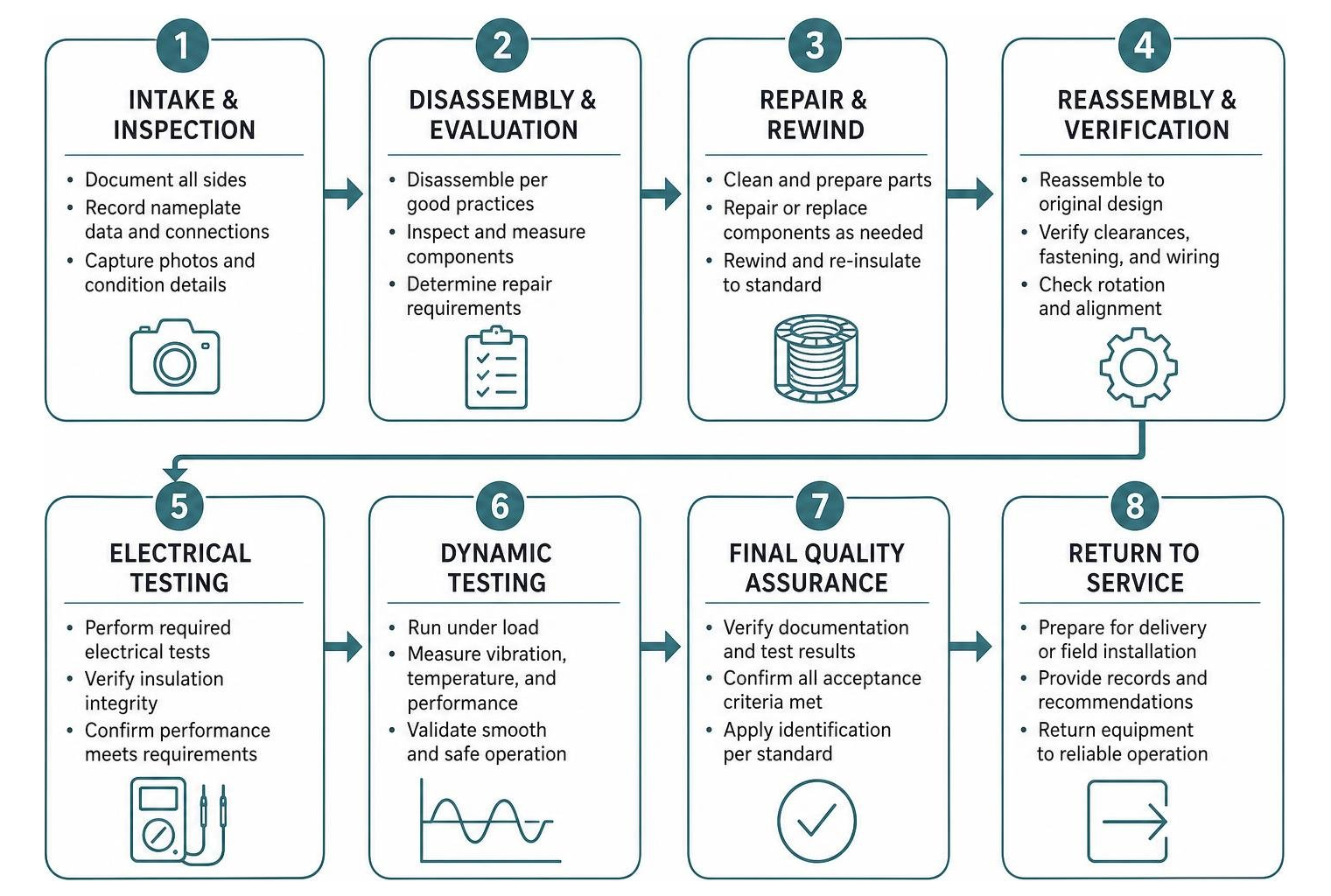
For plant teams and motor owners, the practical takeaway is simple: ask whether a repair provider follows the current ANSI/EASA AR100-2025 practices and documents the work. The standard helps define what good repair looks like, from recording the motor’s incoming condition to checking winding balance, insulation, runout, and final operating performance.
First approved as an American National Standard in 1998, AR100 has been updated on a five-year cycle. The current 2025 edition includes 72 changes, including updates for onsite repairs, winding tests, magnetic wedges, and mechanical tolerances. These details matter because small repair choices can have major operating effects. For example, substituting nonmagnetic wedges for magnetic wedges in a form-wound stator can raise winding temperature by 20 C or more.
This guide explains what the standard covers, what changed in 2025, and how its requirements support reliable, efficient rotating equipment.
The Evolution and Authority of ANSI/EASA AR100 in Motor Repair
To appreciate the authority of the ANSI/EASA AR100 standard, it helps to understand where it began. The roots of formal electromechanical rebuilding practices trace back to 1933 with the founding of the National Industrial Service Association (NISA) during the Great Depression. By 1945, NISA established the initial Electric Motor and Generator Rebuilding Standards, even offering physical adhesive labels that shops could affix to repaired units to certify workmanship. NISA eventually evolved into the Electrical Apparatus Service Association (EASA) in 1962, representing more than 1,700 electromechanical sales and service firms across nearly 70 countries.
During the 1990s, the U.S. government implemented strict efficiency mandates on newly manufactured industrial machinery. This raised concerns that unverified rewinding could compromise operating performance. In response, EASA sought accreditation as an independent standards developer rather than partnering with other bodies, ensuring repair guidelines remained grounded in real-world electromechanical engineering. This effort led to the formal approval of ANSI/EASA AR100-1998 as an American National Standard.
Under American National Standards Institute (ANSI) essential requirements, only one official national standard is recognized per topic, making ANSI/EASA AR100 the sole benchmark for rotating machine repair in the United States. ANSI mandates that standards be reaffirmed or updated every five years through a balanced consensus body composed of service centers, end users, test laboratories, and regulatory representatives. Consecutive revisions in 2001, 2006, 2010, 2015, 2020, and the latest 2025 edition maintain this consensus. You can explore this developer governance through the ANSI Accredited Standards Developer Information documentation.
Rigorous rewind studies conducted in 2003 and 2019 proved that modern energy-efficient and Premium Efficiency (IE3) electric motors can undergo comprehensive rewinding and rebuilding without degrading baseline energy efficiency, provided technicians follow verified good practices.
Understanding the Scope of ANSI/EASA AR100 Across Apparatus Types
The standard establishes guidelines for induction machines, synchronous equipment, wound-rotor stators, and direct current apparatus. Over decades of revisions, the committee intentionally streamlined the standard’s focus:
- Commercial terms, warranties, and power hand tools were removed to maintain strict technical focus.
- Stationary transformer rebuilding was separated into its own publication (EASA AR200).
- Terminal marking and connection protocols were aligned directly with NEMA MG 00001 (the modern successor to NEMA MG 1).
Whether performing routine AC repairs on low-voltage squirrel-cage motors or executing intricate DC repairs on industrial traction armatures, AR100 outlines every phase of work. Specialized applications—such as explosion-proof enclosures, Class 1E nuclear safety installations, or hermetic submersibles—use AR100 as their technical foundation alongside specialized regulatory supplements.
Onsite Field Servicing Versus In-Shop Repair Standards
A key clarification in modern editions is the formal broadening of scope under Clause 1.1. While major overhauls traditionally take place inside a controlled service center environment, the standard explicitly applies its repair practices and tolerances to mobile field services as well.
Whether an overhaul occurs on a clean repair bench or directly inside a customer’s processing facility, technicians must capture comprehensive intake photographs of all sides of the apparatus. Documenting terminal lead arrangements, accessory configurations, and nameplate data upon arrival ensures critical baseline parameters are preserved before disassembly begins.
Major Technical Updates in the 2025 Edition
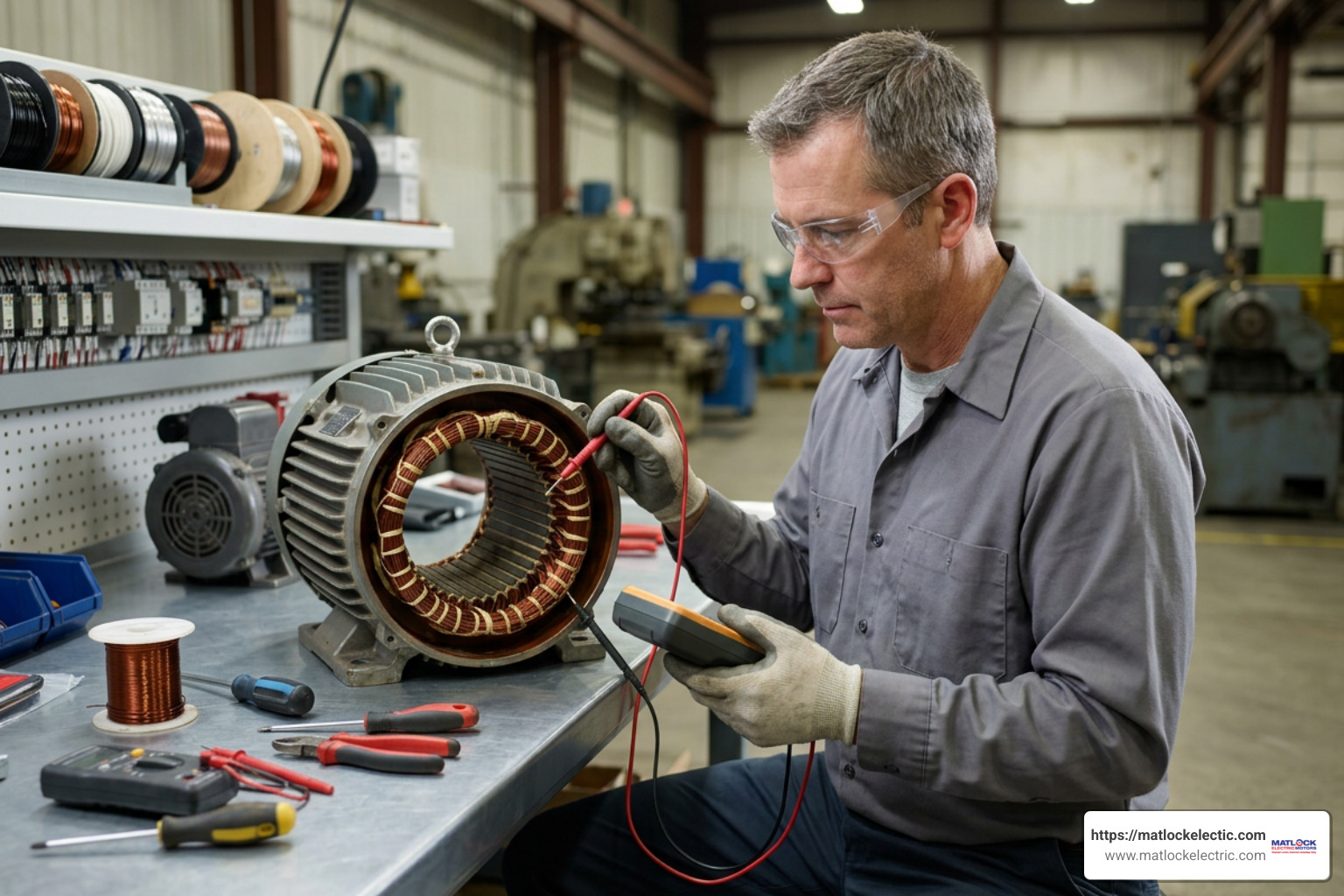
Following approval by the ANSI Board of Standards Review, the standard was published as ANSI/EASA Standard AR100-2025: Recommended Practice for the Repair of Rotating Electrical Apparatus. The 2025 revision introduces 72 distinct revisions, consisting of 48 substantive technical modifications and 24 editorial refinements.
These updates place heavy emphasis on protecting laminated core structures. Stator core burnout and stripping oven temperatures must be closely regulated to eliminate the risk of frame distortion or breakdown of the thin interlaminar insulation between core laminations. If inspection reveals evidence of hot spots, a core loss test must be conducted immediately. For stationary field coils, the 2025 release officially recognizes wet winding methods as an approved treatment process alongside traditional post-winding vacuum pressure impregnation.
Stator Core, Magnetic Wedges, and Thermal Protection
One of the most consequential technical updates involves stator slot wedges. In high-efficiency and form-wound motors, original equipment manufacturers often utilize magnetic wedges to bridge slot openings, which smooths magnetic flux distribution across the radial air gap.
If a service facility mistakenly replaces magnetic wedges with standard nonmagnetic alternatives during a rewind, the motor suffers significant magnetic degradation. The resulting slot harmonics and flux distortion can cause a winding temperature rise of 20°C or more, alongside elevated no-load magnetizing current and reduced operating efficiency. The 2025 standard mandates that magnetic wedges must only be replaced with materials exhibiting equivalent or superior magnetic properties.
Additionally, the standard recommends replacing old metallic surge rings with purpose-built surge rope of equal or larger diameter. This eliminates the risk of inductive ring heating and ground faults while providing superior mechanical restraint against winding movement during startup surges. Thermal protectors and embedded sensors must also be matched to original electrical and thermal ratings, and they can only be eliminated with explicit customer authorization.
Mechanical Tolerances, Shaft Runout, and Sleeve Bearings
Mechanical guidelines in AR100-2025 have transitioned from complex dimension-based tables to a streamlined speed-based format (Table 2-3), correlating operating RPM directly to Allowable Total Indicated Runout (TIR):
- Rotor Core Outside Diameter Runout: For 2-pole machines running at high velocities, maximum allowable core OD runout relative to the bearing journals is capped at 0.003 inches (0.08 mm). For 4-pole and slower machines, runout must not exceed 5% of the average radial air gap.
- Coupled Horizontal Sleeve Bearings: Guidelines address rotor axial float and end-thrust containment, mandating the use of limited end-float couplings to prevent bearing babbitt damage.
- Collector Ring Tolerances: Runout limits for slip rings are categorized across three peripheral speed tiers: under 2,500 ft/min (760 m/min), 2,500 to 5,000 ft/min, and greater than 5,000 ft/min (1,525 m/min).
- Dynamic Balancing: Rotating assemblies for applications like servo motor repair must adhere to rigid balance quality grades to prevent premature bearing fatigue and high-frequency frame vibration.
Electrical Testing Protocols and Quality Verification

Electrical verification ensures that repaired apparatus can withstand real-world line transients. Technicians rely on comprehensive methods detailed in our guide on troubleshooting motors a practical guide to resistance testing and advanced technology in diagnostics to evaluate dielectric integrity.
Key testing benchmarks reinforced across recent editions include:
- High-Potential Proof Testing: Section 4.4.1.1 dictates that post-rewind hi-pot proof testing on new windings must never exceed 80% of the original factory test voltage standard ($2 times V_{text{rated}} + 1000text{V}$), preventing insulation stress during routine re-testing.
- Phase Balance Testing: When assessing winding symmetry, balanced 3-phase power is applied at reduced voltage (15% to 20% of rated nameplate voltage) for a duration not exceeding 5 minutes, drawing current approximately equal to full load rating.
- Proportional Volts/Hertz No-Load Runs: When testing facilities lack the specific rated frequency of a machine (such as testing a 50 Hz export motor on a 60 Hz grid), technicians run no-load tests using an equivalent volts-per-hertz ratio without exceeding rated operating voltage or safe mechanical speed.
Random-Wound vs. Form-Wound Stator Testing Guidelines
Winding construction dictates the appropriate testing protocol:
| Testing Parameter | Random-Wound Windings | Form-Wound Windings |
|---|---|---|
| Phase Resistance Unbalance | Maximum 2% variation from average | Maximum 1% variation from average |
| Dielectric Absorption Evaluation | 60/30 Second IR Ratio (threshold $ge 1.5$) | 10-Minute / 1-Minute Polarization Index (P.I.) |
| Surge Comparison Testing | Waveform comparison per IEEE 522 | Voltage-matched surge testing by kV rating |
| Uncured / Green VPI Coils | Typically not applicable | Pre-agreed reduced test voltages |
In random-wound stators, absorption currents drop almost instantaneously within the first few seconds of DC voltage application. Consequently, attempting a traditional 10-minute to 1-minute Polarization Index (P.I.) often yields inconclusive results. AR100-2025 recognizes a 60/30 second Insulation Resistance (IR) ratio test (per IEEE 1068) as a reliable alternative, using a pass threshold of 1.5.
Best Practices for DC Armatures and Commutator Assemblies
Direct current machines require specific mechanical and electrical care:
- Insulation Resistance Thresholds: In alignment with IEEE 43, minimum insulation resistance benchmarks for DC armatures require a minimum $R_{text{1min}} = 5,text{M}Omega$ at 40°C.
- Bar-to-Bar Armature Testing: Technicians utilize high-frequency or low-resistance bar-to-bar comparative testing across commutator segments to locate shorted turns or high-resistance riser connections.
- Commutator Maintenance: Following diamond turning and mica undercutting, both trailing and leading edges of every copper bar must be chamfered. This can be accomplished manually or with purpose-designed abrasive nylon brushes to prevent copper burrs from causing brush chatter and electrical flashover.
- Equalizing Jumpers: DC brush rigging must include low-resistance equalizing jumpers connecting brush posts of identical polarity to eliminate circulating currents and unequal voltage sparking.
Service Center Compliance and Industry Accreditation
Following ANSI/EASA AR100 standard practices protects facility reliability and reduces operational risk. When plant managers send mission-critical equipment out for service, third-party accreditation verifies that the repair facility has the calibrated instruments, temperature-controlled ovens, and trained technicians required to do the job right.
Maintaining documented quality systems is why Matlock recognized as EASA accredited service center status provides tangible value to maintenance departments. Independent third-party audits evaluate service centers against dozens of specific criteria derived directly from AR100. This rigorous oversight ensures your equipment is repaired to national standards, helping you keep your business humming finding reliable local electric motor repair partners who deliver consistent quality.
Accreditation Program Alignment with ANSI/EASA AR100
AR100 serves as the primary technical foundation for the EASA Accreditation Program checklist. While the standard undergoes broader revisions, the accreditation checklist incorporates targeted mandatory requirements.
For example, the only technical change in the 2025 standard that directly impacted the official Accreditation Program Checklist was Clause 3.11 (Wedges), which requires documented verification that replacement wedges preserve original magnetic specifications, taking mandatory audit effect in January 2027. Service centers combine these winding practices with predictive maintenance tools—as explored in the story behind thermal imaging—to document that every repaired motor delivers optimal thermal and mechanical performance before re-entering industrial service.
Frequently Asked Questions About ANSI/EASA AR100
What happens if magnetic wedges are replaced with nonmagnetic wedges?
Replacing original magnetic slot wedges with nonmagnetic alternatives (such as plain G11 or epoxy glass) disrupts the motor’s designed magnetic circuit. This substitution increases radial air gap flux distortion and high-frequency rotor losses, resulting in a winding temperature increase of 20°C or more. It also draws higher no-load magnetizing current, reduces overall motor operating efficiency, and shortens the insulation system’s operating lifespan.
Does ANSI/EASA AR100 apply to field or onsite motor repairs?
Yes. Clause 1.1 of the standard explicitly states that while rotating machine rebuilds are routinely performed in fully equipped repair facilities, its technical requirements, tolerances, and testing protocols apply equally to repairs performed onsite. Field technicians must adhere to the same mechanical runout tolerances, core handling procedures, and electrical testing standards used inside an accredited service center.
Why is the 60/30 second IR ratio used instead of Polarization Index for random windings?
In modern random-wound insulation systems, the dielectric absorption current frequently drops to near zero within seconds of energization. Because the leakage current stabilizes rapidly, running a 10-minute Polarization Index test often results in dividing by extremely low, fluctuating current values, producing misleading P.I. numbers. Measuring the insulation resistance ratio between 60 seconds and 30 seconds provides a reliable, repeatable indicator of dielectric integrity with an established acceptance ratio of 1.5.
Conclusion
Adhering to national standards during electric motor repair protects plant productivity, prevents unplanned downtime, and preserves nameplate energy efficiency. ANSI/EASA AR100 establishes clear guidelines for every phase of rotating apparatus repair—from incoming photography and temperature-controlled coil stripping to precision dynamic balancing and final surge testing.
When your industrial processes depend on continuous, trouble-free operation, partner with a certified service team committed to quality workmanship and standard compliance. Contact Matlock Electric for comprehensive motor repair and accredited service that returns your mission-critical equipment to peak operating condition.